This year's Mother's Day was unconventional. I spent the bulk of its daylight hours on the road, headed toward Knoxville on a rather sad errand; returning from Knoxville in a contemplative frame of mind. The length of Highway 27 beat the interstate for scenery, if not for speed: slanting green-blue ridges piling up behind one another in the bright sunlight, flawless blue skies, and sweet little towns with biblical names (Mount Pisgah, New Salem). I passed several cemeteries where visitors were paying their respects, and speculated on the connection of the holiday to their ministrations. The idea of life being so breathtaking and yet quotidian, so full and at the same time so transient, held my mind in thrall, lending each scene a fresh poignancy.
The earth is full of the knowledge of God. I felt this powerfully: a knowledge, unspoken but palpable and immense, on that long drive. I felt it as the source of the "dearest freshness deep down things" that you rejoice in when you pause to note it. The sun knew, radiating its wave/lines of energy across the landscape. The mountains knew, bristling with their current crop of plants and creatures, enfolding the memories of generations before in the accrued sediments of centuries. "For all this, nature is never spent."
But how many of us knew--in our houses, playgrounds, trailers, gas stations, cars? In our landscape bleared, smeared with toil, dressed in our very scent and smudge? In the heartbeat span of our generation treading water (how briefly), the memories of the trodden ones before us?
How do we then not reck His rod?
Monday, May 10, 2010

Monday, April 26, 2010
Sometimes I think about how much nicer life would be if feelings did not exist. When I wake up tired and sluggish and perhaps a wee bit grumpy, for example. What is the use of feeling those things? They are like that obnoxious person who is bound to point out the obvious reasons for the things that ail you, without offering any solution. "You should not have gone to bed so late last night," your heavy eyelids admonish. "Nor should you have had so many sugary things," your puffy face avers, while your aching muscles demand, "What were you thinking, drinking all that coffee?" They have no bearing on the fact that I am nevertheless required to get out of bed, shower, dress, glug a mug of coffee, and go to work. They just make it more difficult to do so with cheer.
Of course, experience has taught me that the best way to deal with such unsolicited and unhelpful input is simply to nod my head in agreement and then count my blessings and focus on the hours ahead. No use letting them get on my nerves. No use arguing. They are right--they are oh so right--but that's all behind me, and today is a completely different matter.
I'm going to go find some pleasant feelings to keep me company.
Of course, experience has taught me that the best way to deal with such unsolicited and unhelpful input is simply to nod my head in agreement and then count my blessings and focus on the hours ahead. No use letting them get on my nerves. No use arguing. They are right--they are oh so right--but that's all behind me, and today is a completely different matter.
I'm going to go find some pleasant feelings to keep me company.
Monday, April 19, 2010
I have a dream.
The dream is Italy.
Everyone falls in love with Italy, to some extent. For some it is a fleeting and faraway crush, a brief fascination. For many the fall is irrevocable and enduring. I have yet to meet a single person who was not at one time intrigued by some aspect of this peerless nation.
Even before the few thrilling days I spent there, I was being primed. I was learning about the Roman Empire and the days of the early church, about the Roman Catholic Church and the Renaissance. I was reading Mandie and the Catacombs, Quo Vadis, An Echo in the Darkness. Middlemarch and A Room With A View and Where Angels Fear to Tread. Under The Tuscan Sun and The Age of Innocence. Roderick Hudson and The Marble Faun. I was watching While You were Sleeping and Return To Me and Gladiator. I was spending my afternoons after school poring over art books in the library: DaVinci and Fra Angelico, Botticelli and Bellini and Caravaggio, Donatello and Giotto and Fra Fillippo Lippi, Titian and Veronese. I was acquiring an idea of Italy.
Then I was there.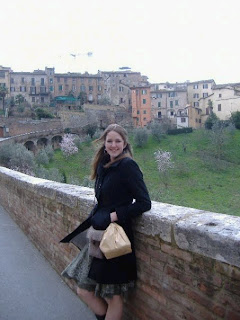 I only spent a week there, but it was long enough to understand that this was a place I wanted to know, to befriend. It was like meeting a famous person, a person I'd heard of but never met, and feeling an affinity...a sense that, under other circumstances, we would become kindred spirits. She would tell me all her secrets, and they would help me understand things about her. I would love her for them. Our friendship would help me understand myself better. It would transform me.
I am determined to live there. It doesn't have to be soon, nor does it have to be forever. But somehow I need to be a part of Italy's story. Italy is already a part of mine.
Everyone falls in love with Italy, to some extent. For some it is a fleeting and faraway crush, a brief fascination. For many the fall is irrevocable and enduring. I have yet to meet a single person who was not at one time intrigued by some aspect of this peerless nation.
Even before the few thrilling days I spent there, I was being primed. I was learning about the Roman Empire and the days of the early church, about the Roman Catholic Church and the Renaissance. I was reading Mandie and the Catacombs, Quo Vadis, An Echo in the Darkness. Middlemarch and A Room With A View and Where Angels Fear to Tread. Under The Tuscan Sun and The Age of Innocence. Roderick Hudson and The Marble Faun. I was watching While You were Sleeping and Return To Me and Gladiator. I was spending my afternoons after school poring over art books in the library: DaVinci and Fra Angelico, Botticelli and Bellini and Caravaggio, Donatello and Giotto and Fra Fillippo Lippi, Titian and Veronese. I was acquiring an idea of Italy.
Then I was there.
I only spent a week there, but it was long enough to understand that this was a place I wanted to know, to befriend. It was like meeting a famous person, a person I'd heard of but never met, and feeling an affinity...a sense that, under other circumstances, we would become kindred spirits. She would tell me all her secrets, and they would help me understand things about her. I would love her for them. Our friendship would help me understand myself better. It would transform me.I am determined to live there. It doesn't have to be soon, nor does it have to be forever. But somehow I need to be a part of Italy's story. Italy is already a part of mine.
Monday, April 12, 2010
hidden will of iron
I am always thrown when relatives express any unsolicited interest in my plans, despite the uncontestable truth that my upbringing should have prepared to me to expect such involvement.
Why do I find it so hard to imagine that my aunts, uncles, cousins, and even siblings, do actually care about me? Why is it so difficult for me to take my family members at face value, rather than reading motivations like pity and a sense of duty into their kindly questions and gentle advice? I guess I am more suspicious and guarded than I give myself credit. And that is saying a lot.
Also, I am private to a fault, particularly in areas of my life where I am unsure of myself. If I am going to go out on a limb, there is no way I'm going to let anyone in on it until I've attained a measure of success. Probably not even then.
Perhaps I've convinced myself that my family truly doesn't care a great deal about the actions I take because I fear the prospect of being a disappointment more than I fear the prospect of being a failure.
Last year I took a personality test in the book Wired That Way and came out very strongly in the "peaceful phlegmatic" camp. One phrase they used to describe this personality group has lingered in my memory. While asserting that peaceful phlegmatics place a high priority on making sure everyone is happy, the book also warned that these outwardly pliable individuals happen to possess a "hidden will of iron."
In a nutshell, this describes my approach to life. I hate when people are unhappy with me, I hate the prospect of disappointing anyone, but there are certain areas of my life where I am brutally inflexible. I will pursue my own dreams. I will try to make these dreams appear as innocuous and palatable as possible in order to make others as happy about them as I am. Or I will simply not share them if I am sure that they will offend. But I will persist in them.
I guess it is this fiercely guarded will of iron that I am nursing when I persuade myself that my family is not truly interested in my plans. I am afraid that if they are truly interested, that if for some reason they are opposed to my will, I will be forced to disappoint them. Much easier to pretend that they are just being polite, and therefore it is okay for me to be casual and evasive in my response.
The book didn't mention cowardice as a side effect of pleaceful phlegmaticism.
Notice, too, the questions I leave pointedly unaddressed. (For example: Am I afraid of talking things out because such discussions might reveal me to be in the wrong? Should I even be pursuing a path that I feel positive my loving devoted family would oppose? Didn't God write a lot about the folly of ignoring advice...of leaning on one's own understanding? Aren't relationships more important than agendas?) Listen to these questions clang against the iron vault of my hidden will.
Why do I find it so hard to imagine that my aunts, uncles, cousins, and even siblings, do actually care about me? Why is it so difficult for me to take my family members at face value, rather than reading motivations like pity and a sense of duty into their kindly questions and gentle advice? I guess I am more suspicious and guarded than I give myself credit. And that is saying a lot.
Also, I am private to a fault, particularly in areas of my life where I am unsure of myself. If I am going to go out on a limb, there is no way I'm going to let anyone in on it until I've attained a measure of success. Probably not even then.
Perhaps I've convinced myself that my family truly doesn't care a great deal about the actions I take because I fear the prospect of being a disappointment more than I fear the prospect of being a failure.
Last year I took a personality test in the book Wired That Way and came out very strongly in the "peaceful phlegmatic" camp. One phrase they used to describe this personality group has lingered in my memory. While asserting that peaceful phlegmatics place a high priority on making sure everyone is happy, the book also warned that these outwardly pliable individuals happen to possess a "hidden will of iron."
In a nutshell, this describes my approach to life. I hate when people are unhappy with me, I hate the prospect of disappointing anyone, but there are certain areas of my life where I am brutally inflexible. I will pursue my own dreams. I will try to make these dreams appear as innocuous and palatable as possible in order to make others as happy about them as I am. Or I will simply not share them if I am sure that they will offend. But I will persist in them.
I guess it is this fiercely guarded will of iron that I am nursing when I persuade myself that my family is not truly interested in my plans. I am afraid that if they are truly interested, that if for some reason they are opposed to my will, I will be forced to disappoint them. Much easier to pretend that they are just being polite, and therefore it is okay for me to be casual and evasive in my response.
The book didn't mention cowardice as a side effect of pleaceful phlegmaticism.
Notice, too, the questions I leave pointedly unaddressed. (For example: Am I afraid of talking things out because such discussions might reveal me to be in the wrong? Should I even be pursuing a path that I feel positive my loving devoted family would oppose? Didn't God write a lot about the folly of ignoring advice...of leaning on one's own understanding? Aren't relationships more important than agendas?) Listen to these questions clang against the iron vault of my hidden will.
Friday, April 09, 2010
let this eye be not folly's loophole
I've been re-reading Marilynne Robinson's Home, and feeling that something about this book is special. For some reason it moves me more deeply than usual.
When I actually took a moment to analyze why this is, I had a revelation. I realized that the difference is not so much in the book itself as it is in my attitude towards it.
Usually when I read a book, my attitude is one of conquest, of entitlement. I'm the conquistador blazing through foreign terrain and seeking to understand it only for my own personal profit. It can be easy for me to emerge from a book having made very little connection with the characters, caring very little about how they end up (or caring only from a scientific distance), and feeling strongly only about how beautifully the author managed to render the scenery. I can draw from it a sense of the picturesque, and perhaps a sweeping overview of the themes that I can, if I desire, apply sweepingly to myself. I can walk away more experienced, perhaps, smarter...but essentially unchanged.
With this book, however, I quickly discover that I am on native soil. It doesn't take long for me to recognize these faces. I am one of them, and that makes all the difference to my posture. I pay each scene, each character, each event the sort of attention (critical and loving) that an insider pays to each landmark or passerby or local occurance. I'm no tourist here, rushing through the highlights of the Baedecker and going my way with only a blur of faces and places lingering in my memory. Rather, these pages turn my gaze both backward and inward, prompt me to pause over memories of the people and places that produced me, and to reflect on my motivations and behavior in both the past and the present.
Embedded in the fictional setting of Gilead, Iowa is a truth I can identify because I have experienced it. And I can let it effect me deeply.
This whole line of thought has me reevaluating the sort of attention I pay to other books. I want to read in order to become a better human--not in order to be regarded as cultured or well-educated. Not to take a little vacation from reality. Not for my own glory or because it simply is the thing to do or because I feel that it will strengthen my morals or broaden my experience. I don't want to be a Cortez of literary frontiers; I don't even want to be a Miss Lavish or an Innocent Abroad.
Books are another sphere in which I can "see in all bodies the beat of spirit," an arena where the "alien hands of love" can touch me if, I let them. Reading opens up yet another place in which I can love my neighbor as myself--where I can learn to be "giver of due regard."
So no more arrogance, entitlement, patronization, generalization as I open each new book.
Instead: humility, teachability, attention, gratitude.
When I actually took a moment to analyze why this is, I had a revelation. I realized that the difference is not so much in the book itself as it is in my attitude towards it.
Usually when I read a book, my attitude is one of conquest, of entitlement. I'm the conquistador blazing through foreign terrain and seeking to understand it only for my own personal profit. It can be easy for me to emerge from a book having made very little connection with the characters, caring very little about how they end up (or caring only from a scientific distance), and feeling strongly only about how beautifully the author managed to render the scenery. I can draw from it a sense of the picturesque, and perhaps a sweeping overview of the themes that I can, if I desire, apply sweepingly to myself. I can walk away more experienced, perhaps, smarter...but essentially unchanged.
With this book, however, I quickly discover that I am on native soil. It doesn't take long for me to recognize these faces. I am one of them, and that makes all the difference to my posture. I pay each scene, each character, each event the sort of attention (critical and loving) that an insider pays to each landmark or passerby or local occurance. I'm no tourist here, rushing through the highlights of the Baedecker and going my way with only a blur of faces and places lingering in my memory. Rather, these pages turn my gaze both backward and inward, prompt me to pause over memories of the people and places that produced me, and to reflect on my motivations and behavior in both the past and the present.
Embedded in the fictional setting of Gilead, Iowa is a truth I can identify because I have experienced it. And I can let it effect me deeply.
This whole line of thought has me reevaluating the sort of attention I pay to other books. I want to read in order to become a better human--not in order to be regarded as cultured or well-educated. Not to take a little vacation from reality. Not for my own glory or because it simply is the thing to do or because I feel that it will strengthen my morals or broaden my experience. I don't want to be a Cortez of literary frontiers; I don't even want to be a Miss Lavish or an Innocent Abroad.
Books are another sphere in which I can "see in all bodies the beat of spirit," an arena where the "alien hands of love" can touch me if, I let them. Reading opens up yet another place in which I can love my neighbor as myself--where I can learn to be "giver of due regard."
So no more arrogance, entitlement, patronization, generalization as I open each new book.
Instead: humility, teachability, attention, gratitude.
Thursday, April 01, 2010
Maundy Thursday
I love the religious calendar. It is as though a bunch of alarm clocks were smuggled into the year, strategically timed to rouse my heart from slumber and open my eyes to the full meaning of my experience.
With every passing year, this song means more for me. Incarnation, Epiphany, Lent, Palm Sunday, Maundy Thursday, Good Friday, Easter, Ascension, Pentecost, and Advent again. This cycle, Christ's cycle, is my cycle, too. Each milestone reminds me of my own experience: new creation, death to self, resurrection, ascension, life eternal. The pattern contains revelation to assure me, promise to thrill me, mystery to keep me reaching.
I look into my heart and count the rings, read the weathers of each particular season: sunshine and rain, draught and flood, harvests abundant and scant. I am consoled to see that, even without my knowledge or desire, each ring came to completion. Each new ring grew wider than the one before.
I think: You are growing.
I may at times feel vulnerable to the elements, at the mercy of the weathers of the world. But then I am reminded that I am a sacred tree, planted beside the living water. My roots tighten their grip. My branches curve up and spread out.
I photosynthesize with zeal.
With every passing year, this song means more for me. Incarnation, Epiphany, Lent, Palm Sunday, Maundy Thursday, Good Friday, Easter, Ascension, Pentecost, and Advent again. This cycle, Christ's cycle, is my cycle, too. Each milestone reminds me of my own experience: new creation, death to self, resurrection, ascension, life eternal. The pattern contains revelation to assure me, promise to thrill me, mystery to keep me reaching.
I look into my heart and count the rings, read the weathers of each particular season: sunshine and rain, draught and flood, harvests abundant and scant. I am consoled to see that, even without my knowledge or desire, each ring came to completion. Each new ring grew wider than the one before.
I think: You are growing.
I may at times feel vulnerable to the elements, at the mercy of the weathers of the world. But then I am reminded that I am a sacred tree, planted beside the living water. My roots tighten their grip. My branches curve up and spread out.
I photosynthesize with zeal.
Monday, March 29, 2010
fry me, sunny side up
Tu Wi's Considers April Sunlight
[Barbara Crooker]
from her copper saucepan, basting the meadow in hollondaise.
Where it drips: buttercups, dandelions, butter & eggs.
Where it splashes: forsythia, daffodils, tulips.
After this long hard winter, I reach out my arms,
lift my face to the sky.
Fry me, sunny side up,
on spring's hot griddle; clarify me, anoint me,
in your lavish lemon light.
[Barbara Crooker]

from her copper saucepan, basting the meadow in hollondaise.
Where it drips: buttercups, dandelions, butter & eggs.
Where it splashes: forsythia, daffodils, tulips.
After this long hard winter, I reach out my arms,
lift my face to the sky.
Fry me, sunny side up,
on spring's hot griddle; clarify me, anoint me,
in your lavish lemon light.
neediness
I want to share exactly how it felt yesterday, to roam an uncharted landscape in a restless sunshine. I want you to partake of Janie's exuberance, as I did, watching her leap from lichened rocks to long-stemmed grasses, snuffle through the wind-wakened cellulite of muddy red puddles, stiffen and prick at the sound of a distant howl.
I want you to feel the strong gentle fingers of the wind rifle through your hair, and the sloppy suction of clay on your tennis shoes, and the pale solar glow warming the backs of your legs. I want you to picture the tiny black flies dancing over every inch of water, and then I want you to zoom out and see the textured earth, hummocks and power lines, trees and grasses, somersaulting down to the skyline.
I want you to know the heady smallness of standing on a mountain-top, drawn to scale, engulfed.
I would even wish for you the satisfaction of scratched ankles, aching muscles, dirt-caked laundry.
I want all of this for you, selfishly, because the only thing that is missing to make my experience complete is human fellowship, and I will not be able to fully enjoy it until I have attempted to share with someone.
I want you to feel the strong gentle fingers of the wind rifle through your hair, and the sloppy suction of clay on your tennis shoes, and the pale solar glow warming the backs of your legs. I want you to picture the tiny black flies dancing over every inch of water, and then I want you to zoom out and see the textured earth, hummocks and power lines, trees and grasses, somersaulting down to the skyline.
I want you to know the heady smallness of standing on a mountain-top, drawn to scale, engulfed.
I would even wish for you the satisfaction of scratched ankles, aching muscles, dirt-caked laundry.
I want all of this for you, selfishly, because the only thing that is missing to make my experience complete is human fellowship, and I will not be able to fully enjoy it until I have attempted to share with someone.
Friday, March 26, 2010
fragments
"I stood there and felt the melancholy / of growing older in such a season"... (Evan Boland)
Growing older in springtime does involve a dimension of melancholy. I am still young, but at the same time I percieve the shadow lengthening behind me where I used to sense only sunshine.
“Youth never sees its shadow till the sun’s about to set: and then you wonder where the person went who you were speaking to in all your thoughts for all those years.” (Marianne Wiggins)
The distance between feeling the melancholy of growing older and seeing that shadow is increasingly short. A degree of circumspection would better befit my behavior than the heedless dithering that has characterized it of late.
Growing older in springtime does involve a dimension of melancholy. I am still young, but at the same time I percieve the shadow lengthening behind me where I used to sense only sunshine.
“Youth never sees its shadow till the sun’s about to set: and then you wonder where the person went who you were speaking to in all your thoughts for all those years.” (Marianne Wiggins)
The distance between feeling the melancholy of growing older and seeing that shadow is increasingly short. A degree of circumspection would better befit my behavior than the heedless dithering that has characterized it of late.
Thursday, March 25, 2010
Nostalgia
When I think of nostalgia, I think of the poem by Emily Dickinson about the certain slant of light. So often the trigger for nostalgia is as simple as that: a slant of light, a waft of fragrance, a familiar melody.
There's a certain slant of light,
On winter afternoons,
That oppresses, like the weight
Of cathedral tunes.
Heavenly hurt it gives us;
We can find no scar,
But internal difference
Where the meanings are.
None may teach it anything,
'Tis the seal, despair,-
An imperial affliction
Sent us of the air.
When it comes, the landscape listens,
Shadows hold their breath;
When it goes, 't is like the distance
On the look of death.
The language Dickinson uses is so powerful that some might object to my labeling it "nostalgic." I would argue that nostalgia and mourning share plenty of common ground. When I feel nostalgic, there is often an element of regret and melancholy, a sense of loss, wistfulness, sentimentality. Similarly, mourning (sorrow over something lost) involves feelings of regret, yearning, and sentimentality. The difference between the two is one of directness. Mourning is always transitive; nostalgia is frequently intransitive. When you mourn, your emotion has a direct object: a clear idea of something or someone that once was there and now is gone. On the other hand, it is possible to feel nostalgic and not even know precisely why. The direct cause can elude you, although you perhaps can link your emotion to the indirect object, which is often its trigger.
In this poem, Emily she isn't speaking about her sorrow over the loss of any tangible thing. She is talking about a slant of light, a familiar enough atmospheric condition that happens on winter afternoons, and about how it makes her feel. How when she sees this slant of light, the injury it gives her is a spiritual affliction, a sense of despair that leaves no outer scar but nevertheless changes the meanings of things for her. It seems to her as though the world is holding its breath, listening. And when it passes, it reminds her of "the distance / on the look of death."
The slant of light is not the cause of her despair. But the sight of it pierces deep to the place where she stores her meanings--the things that are important to her, that help her make sense of the world (memories, for instance)--and casts a painful chill over her spirit.
That is nostalgia. It doesn't always come with such intensity, nor is it always a stirrer of grief. But it always makes internal difference, where our meanings are.
Tuesday, March 23, 2010
I'm ready for a ready heart
I found in this quote the sting of conviction and the relief of enlightenment. Blessed are the meek, indeed.
"Isn't this the simple explanation for our being so heavy-laden, so tired, so overburdened and confused and bitter? We drag around such prodigious loads of resentment and self-assertion. ... Meekness is teachability. It is the readiness to be shown, which includes the readiness to lay down my fixed notions, my objections and 'what ifs' or 'but what abouts,' my certainties about the rightness of what I have always done or thought or said. It is the child's glad 'Show me! Is this the way? Please help me.' It shows in the kind of attention we pay to one another, the tone of voice we use, the facial expression. The weapon of meekness counters all enmity, says author Dietrich Von Hildebrand, with the offer of an unshielded heart." [Elisabeth Elliot]
"Isn't this the simple explanation for our being so heavy-laden, so tired, so overburdened and confused and bitter? We drag around such prodigious loads of resentment and self-assertion. ... Meekness is teachability. It is the readiness to be shown, which includes the readiness to lay down my fixed notions, my objections and 'what ifs' or 'but what abouts,' my certainties about the rightness of what I have always done or thought or said. It is the child's glad 'Show me! Is this the way? Please help me.' It shows in the kind of attention we pay to one another, the tone of voice we use, the facial expression. The weapon of meekness counters all enmity, says author Dietrich Von Hildebrand, with the offer of an unshielded heart." [Elisabeth Elliot]
Monday, March 22, 2010
fancy
The World
I would like to write a poem about the world that has in it
I would like to write a poem about the world that has in it
nothing fancy.
But it seems impossible.
Whatever the subject, the morning sun
glimmers it.
glimmers it.
The tulip feels the heat and flaps its petals open
and becomes a star.
The ants bore into the peony bud and there is the dark
pinprick well of sweetness.
pinprick well of sweetness.
As for the stones on the beach, forget it.
Each one could be set in gold.
So I tried with my eyes shut, but of course the birds
were singing.
And the aspen trees were shaking the sweetest music
out of their leaves.
And that was followed by, guess what, a momentous and
beautiful silence
as comes to all of us, in little earfuls, if we're not too
hurried to hear it.
As for spiders, how the dew hangs in their webs
even if they say nothing, or seem to say nothing.
So fancy is the world, who knows, maybe they sing.
So fancy is the world, who knows, maybe the stars sing too,
and the ants, and the peonies, and the warm stones,
so happy to be where they are, on the beach, instead of being
locked up in gold.
locked up in gold.
-Mary Oliver-
Friday, March 19, 2010
Ah, youth

It's been a joyous day so far. The air is elastic, tingling with spring. I may have been handpicked for trouble by some malignant star lately, but I'm not letting that get me down. After all: I'm juiced up on coffee, sleep, and sunbeams, and my brain is just teeming with hair-brained solutions to every dilemma I face.
Wednesday, March 17, 2010
R.I.P.

LeBaron, Chrysler (1994-2010)
I will miss the way your windshield, with its jagged crack along the length of the dash, shrieked like a kid on a rollercoaster everytime I pushed you upwards of 45 mph.
I will miss how I'd have to turn the wheel ever so slightly to the left in order to drive a straight line.
I will miss that little warning shimmy you'd do if I speeded over 80 mph. Also the way you'd resign to the speed and go straight as an arrow at 95.
We've made so many memories, LeBaron. Like the time when it was snowing so hard, and we catapulted into a ditch only a half an hour from home, and you kept me warm while we waited for the tow truck. Or on a particular visit to Canada, when you took the brunt of some mean off-the-cuff poems, created by me and my sister. (I'm sorry. We were very bored.) Remember Black Thursday? You were so great, especially last year, when you submitted graciously between retail destinations to gallonful doses of cold water in your radiator . Although you suffered from turn signal failure, you never let it stop you. The indignity of my litter--mugs and popcans, scraps of paper, ketchup packets--you tolerated without complaint.
My driveway was so cruel but you weathered it daily, multiple times even, with bounce and aplomb, shooting all those pebbles back into the road (zing!) with disdain.
You carried me to Michigan and back four times, to Canada and back once. We've visited South Carolina and Atlanta.
I only regret that I put off all the other road trips we'd idly planned until it was too late.
The last image that I have of you--your unlit headlights facing me in the chilly gray afternoon as you were towed onto Scenic Highway--haunts me still. I didn't know I was saying goodbye.
I didn't deserve you, LeBaron.
Rest in peace.
I will miss the way your windshield, with its jagged crack along the length of the dash, shrieked like a kid on a rollercoaster everytime I pushed you upwards of 45 mph.
I will miss how I'd have to turn the wheel ever so slightly to the left in order to drive a straight line.
I will miss that little warning shimmy you'd do if I speeded over 80 mph. Also the way you'd resign to the speed and go straight as an arrow at 95.
We've made so many memories, LeBaron. Like the time when it was snowing so hard, and we catapulted into a ditch only a half an hour from home, and you kept me warm while we waited for the tow truck. Or on a particular visit to Canada, when you took the brunt of some mean off-the-cuff poems, created by me and my sister. (I'm sorry. We were very bored.) Remember Black Thursday? You were so great, especially last year, when you submitted graciously between retail destinations to gallonful doses of cold water in your radiator . Although you suffered from turn signal failure, you never let it stop you. The indignity of my litter--mugs and popcans, scraps of paper, ketchup packets--you tolerated without complaint.
My driveway was so cruel but you weathered it daily, multiple times even, with bounce and aplomb, shooting all those pebbles back into the road (zing!) with disdain.
You carried me to Michigan and back four times, to Canada and back once. We've visited South Carolina and Atlanta.
I only regret that I put off all the other road trips we'd idly planned until it was too late.
The last image that I have of you--your unlit headlights facing me in the chilly gray afternoon as you were towed onto Scenic Highway--haunts me still. I didn't know I was saying goodbye.
I didn't deserve you, LeBaron.
Rest in peace.
muddles
"Take an old man's word; there's nothing worse than a muddle in all the world. It's easy to face Death and Fate, the things that sound so dreadful. It is on my muddles that I look back with horror--on the things that I might have avoided. We can help one another but little. I used to think I could teach young people the whole of life, but I know better now, and all my teaching of George has come down to this: beware of muddle. ...Though life is very glorious, it is difficult. ...'Life' wrote a friend of mine, 'is a public performance on the violin, in which you must learn the instrument as you go along.' I think he puts it well. Man has to pick up the use of his functions as he goes along--especially the function of Love."
[A Room With A View]
Monday, March 15, 2010
See Jan(ie) Run. Laugh Jan(ie), Laugh.
Today didn't start off very well.
I had car trouble. I was nearly late for work. The bathrooms and lobbies that had been so starched and clean when I left them Friday looked positively hung-over when I arrived this morning. A bathroom spray nozzle rewarded my efforts to clean out a shower stall by spraying foamy green cleaning chemical all down the front of my jeans. I still don't know what caused the excruciating charlie horse in the fourth toe of my right foot a few moments later. My workers (bless them) were too cheerful and peppy to suit my cranky frame of mind.
But why am I even mentioning this? All of that misery vanished at the sight of my dog DOING A SOMERSAULT through the leaf-strewn grass of my front yard in her unbridled zeal to greet me: hunched, mopey me with that huge invisible chip on my shoulder that she didn't perceive, thank goodness. The fervent joy of her gallop was contagious--I swear, she was laughing. Just picture how, in the breeze of her approach, her ears flapped and tongue lolled with goofy dignity. Try not to smile. The way she plopped in the grass at my feet and craned her head back for a better view while her entire hind end waggled in the grass had me feeling like royalty.
Now here I sit in my snug silent living room, sipping tea and smiling. Janie is curled up at my feet with a spoonful of crunchy peanut butter. I can hardly remember how grumpy feels. The day may not be young, but it is aged to a tranquil mellow that suits me just fine. Time for me to read some poems.
I had car trouble. I was nearly late for work. The bathrooms and lobbies that had been so starched and clean when I left them Friday looked positively hung-over when I arrived this morning. A bathroom spray nozzle rewarded my efforts to clean out a shower stall by spraying foamy green cleaning chemical all down the front of my jeans. I still don't know what caused the excruciating charlie horse in the fourth toe of my right foot a few moments later. My workers (bless them) were too cheerful and peppy to suit my cranky frame of mind.
But why am I even mentioning this? All of that misery vanished at the sight of my dog DOING A SOMERSAULT through the leaf-strewn grass of my front yard in her unbridled zeal to greet me: hunched, mopey me with that huge invisible chip on my shoulder that she didn't perceive, thank goodness. The fervent joy of her gallop was contagious--I swear, she was laughing. Just picture how, in the breeze of her approach, her ears flapped and tongue lolled with goofy dignity. Try not to smile. The way she plopped in the grass at my feet and craned her head back for a better view while her entire hind end waggled in the grass had me feeling like royalty.
Now here I sit in my snug silent living room, sipping tea and smiling. Janie is curled up at my feet with a spoonful of crunchy peanut butter. I can hardly remember how grumpy feels. The day may not be young, but it is aged to a tranquil mellow that suits me just fine. Time for me to read some poems.
Friday, March 12, 2010
freewriting
I've never much enjoyed the discipline of "freewriting."
In elementary school and middle school, my teachers would scold me for my frequent anguished pauses during our sixty-second freewrite sessions. "Abby, the point is not to get it perfect. Don't worry about spell checks or revision. That comes later. Just get what you're feeling onto the paper, okay?"
So I'd sit there in a paralysis of possibilities, and resort at last to writing lines. "I will not revise. I will not spell check. I will write what I feel. I will not revise. I will not spell check..." The buzzer would go off and I'd turn the paper in with a sense of mingled relief and failure, imagining the scorn with which my teacher would read it later: "Poor girl's a parrot. No originality at all."
Those paralyzed sessions at my desk were prophecies. Little did I know then how symptomatic my revulsion to freewriting was. The affliction to which it pointed was far more sinister than mere "lack of originality." It was lack of artlessness. It was crippling inhibition.
My super-ego constantly played Charlotte Bartlett (hypersensitive, controlling, and pathetic) to my ego's baffled and hesitatingly compliant Lucy Honeychurch. As I'd put the pencil to the page and initiate a clumsy and unpolished sentence ("indelicate" perhaps, but "at the same time, beautiful"), the pinched inner voice would gasp in horror and squeak, "Oh, but that won't do. I'd never forgive myself if I permitted you to commit this act of indiscretion. Best to phrase it this way..."
I could not express freely "what I felt" (as my Mr. Beebe or Mr. Emerson of a teacher urged) because of my mind's spinsterly chaperone. Nor could I proceed with the caution she required because of the time restraint. There was nothing to do, then, but to take refuge in parrotry.
That tension has only intensified as I've grown. In my relationships, in my writing, in my reactions to events, I constantly feel my heart rise to express how I feel--the restraining hand of social mores siezing it--and my lips spilling out some dull but safe Cecil Vyse of a cliche in response.
This cycle is wrong. It is false. I hate it.
I want my expressions of self to be beautiful, even if they are indelicate. I want to know what it's like to freewrite my feelings.
I want George Emerson. I want a room with a view.
In elementary school and middle school, my teachers would scold me for my frequent anguished pauses during our sixty-second freewrite sessions. "Abby, the point is not to get it perfect. Don't worry about spell checks or revision. That comes later. Just get what you're feeling onto the paper, okay?"
So I'd sit there in a paralysis of possibilities, and resort at last to writing lines. "I will not revise. I will not spell check. I will write what I feel. I will not revise. I will not spell check..." The buzzer would go off and I'd turn the paper in with a sense of mingled relief and failure, imagining the scorn with which my teacher would read it later: "Poor girl's a parrot. No originality at all."
Those paralyzed sessions at my desk were prophecies. Little did I know then how symptomatic my revulsion to freewriting was. The affliction to which it pointed was far more sinister than mere "lack of originality." It was lack of artlessness. It was crippling inhibition.
My super-ego constantly played Charlotte Bartlett (hypersensitive, controlling, and pathetic) to my ego's baffled and hesitatingly compliant Lucy Honeychurch. As I'd put the pencil to the page and initiate a clumsy and unpolished sentence ("indelicate" perhaps, but "at the same time, beautiful"), the pinched inner voice would gasp in horror and squeak, "Oh, but that won't do. I'd never forgive myself if I permitted you to commit this act of indiscretion. Best to phrase it this way..."
I could not express freely "what I felt" (as my Mr. Beebe or Mr. Emerson of a teacher urged) because of my mind's spinsterly chaperone. Nor could I proceed with the caution she required because of the time restraint. There was nothing to do, then, but to take refuge in parrotry.
That tension has only intensified as I've grown. In my relationships, in my writing, in my reactions to events, I constantly feel my heart rise to express how I feel--the restraining hand of social mores siezing it--and my lips spilling out some dull but safe Cecil Vyse of a cliche in response.
This cycle is wrong. It is false. I hate it.
I want my expressions of self to be beautiful, even if they are indelicate. I want to know what it's like to freewrite my feelings.
I want George Emerson. I want a room with a view.
Friday, March 05, 2010

Thursday, March 04, 2010
What was the subconscious impulse that prompted the circuits in my skull to begin pulsating to the nauseatingly cheesy rhythm of I'll be your wish I'll be your dream I'll be your fantasy? For whatever reason, when I staggered into the kitchen this morning to make myself some coffee, Savage Garden was in my head.
I wonder if King David ever woke up to the Shema Yisrael ringing in his ears. His bodyguards may have heard him muttering it absently as he paced the Jerusalem battlements. Homeric storytellers probably lived most of their lives with fragments of the Illiad and Odyssey running on repeat through their brains. ("Honey, I just can't get that 'rosy fingered dawn' phrase out of my head today!") And so on.
The brain's habit of latching onto a memorized piece has probably initiated countless conversations throughout history that resemble the one I had with my housemate a few hours ago. Conversations starting with "Guess what I've had in my head ever since I woke up?"and concluding with a joint performance of the particular bit of human genius under discussion.
Maybe it's a rudimentary way of preserving and transmitting our cultural heritage. In which case, I am not sure how I feel on this particular day about my brain's selectivity. Yikes.
At any rate, it's fun to think about...and gives my psyche a pleasant break from the song that feels like it will be in my head forever ("until the sky falls down on me").
I wonder if King David ever woke up to the Shema Yisrael ringing in his ears. His bodyguards may have heard him muttering it absently as he paced the Jerusalem battlements. Homeric storytellers probably lived most of their lives with fragments of the Illiad and Odyssey running on repeat through their brains. ("Honey, I just can't get that 'rosy fingered dawn' phrase out of my head today!") And so on.
The brain's habit of latching onto a memorized piece has probably initiated countless conversations throughout history that resemble the one I had with my housemate a few hours ago. Conversations starting with "Guess what I've had in my head ever since I woke up?"and concluding with a joint performance of the particular bit of human genius under discussion.
Maybe it's a rudimentary way of preserving and transmitting our cultural heritage. In which case, I am not sure how I feel on this particular day about my brain's selectivity. Yikes.
At any rate, it's fun to think about...and gives my psyche a pleasant break from the song that feels like it will be in my head forever ("until the sky falls down on me").
Monday, March 01, 2010
I'm sitting in my living room, soaking up the silence and sipping pop after a long and productive day. The lovely thing about my job is that it affords me one tangible arena where I can work, see immediate results, and go home feeling satisfied and useful. I ache to feel that way in every area of my life, but instead feel inadequate or even downright burdensome. The knowledge that I cannot handle everything on my own gnaws at me constantly. I never realized before how much I hate to ask for help, how much of my life revolves around my delusions of autonomy. And oh, what delusions they are.
I survey my many recurring messes. I wrangle with uncertainties about housing and schooling and transportation and finances.
And I realize that really there's nothing for it but to summon my sense of humor and eat my loaded slice of humble pie with wry but hearty laughter.
I survey my many recurring messes. I wrangle with uncertainties about housing and schooling and transportation and finances.
And I realize that really there's nothing for it but to summon my sense of humor and eat my loaded slice of humble pie with wry but hearty laughter.
Subscribe to:
Posts (Atom)