Scrap looked up at the pine trees motionless among stars. Beauty made you love, and love made you beautiful...
She pulled her wrap closer round her with a gesture of defence, of keeping out and off. She didn't want to grow sentimental. Difficult not to, here: the marvellous night stole in through all one's chinks, and brought in with it, whether one wanted them or not, enormous feelings--feelings one couldn't manage, great things about death and time and waste; glorious and devastating things, magnificent and bleak, at once rapture and terror and immense, heart-cleaving longing. She felt small and dreadfully alone. She felt uncovered and defenceless. Instinctively she pulled her wrap closer. With this thing of chiffon she tried to protect herself from the eternities.
excerpt, The Enchanted April (Elizabeth Von Arnim)
Tuesday, September 14, 2010

Monday, September 06, 2010
presence of mind
The ferns outside my window are spreading their green vertebrae out towards the sun-gilded breeze this morning, looking as beautific as ferns are capable of looking. This day is beautific. I am sitting at my kitchen table and soaking up the mingled accords of cleanliness (bleach and Windex), sumptuousness (coffee in the pot and an apple cinnamon coffee cake cooling on the counter), and clean mountain air. My dishwasher is running, I'm eyeing one of the peaches nestled in a bowl on my kitchen table with undisguised intent, and Rosie Thomas is singing about October.
Earlier today, I visited the grocery store and stocked my refrigerator and cupboards with abundant food in eager anticipation of the advent of two very dear friends, who arrive tomorrow for a small reunion. Later on, I'll finish my preparations by running a few loads of laundry, cleaning the bathroom, and readying the spare mattress. For now, though, I'm pausing to be still and attentive in this gentle light.
I was listening to NPR yesterday while I fixed myself a pizza after church. Every Sunday afternoon the station has a show about some aspect of spirituality, which involves interviewing spiritual people and asking them to divulge their secrets. Of late the majority of these interviews have focused on the Buddhist path to enlightenment, and I am enjoying learning more about this particular approach to life. The most valuable concept that I have taken from these interviews is the concept of being present to your own life.
My inclination is to withdraw into my own consciousness and live a shadow life, in my brain and imagination. I'm particularly prone to this brand of escapism when I am feeling pressured or upset, but it also strikes when I'm simply bored with my routines. Thanks to NPR and a few wonderful books (as always, Mary Oliver, along with Robert Hass, Kathleen Norris, and Thoreau) I have realized that in so doing I am despising the day of small things and cheating myself of a rich life: a life in the body as well as the spirit, in time as well as eternity.
I really don't know how best to hold myself at bay, so to speak, and live a physically present life while also managing to live a metaphysically present life. By nature I veer into extremes. But I know things that help me. I know that certain activities stimulate both my body and spirit at once. Beautiful mountain jogs come to mind most powerfully. Also: listening to the radio while fixing food, running through my Italian CDs while cleaning house, holding a cup of coffee while reading a good book. Blogging while savoring a tidy fragrant kitchen.
L'Engle talks about being ontological, how impossible it is, and yet how fleetingly ineffable those moments of near-ontology are. Mary Oliver talks about being attentive and corporeal as a sort of prayer. I don't know how to be ontological, I don't really know how to be a prayer, but I am willing to try to be present in body and mind. I'm willing to try to love this life.
On a beautific day like today, it seems almost easy.
Earlier today, I visited the grocery store and stocked my refrigerator and cupboards with abundant food in eager anticipation of the advent of two very dear friends, who arrive tomorrow for a small reunion. Later on, I'll finish my preparations by running a few loads of laundry, cleaning the bathroom, and readying the spare mattress. For now, though, I'm pausing to be still and attentive in this gentle light.
I was listening to NPR yesterday while I fixed myself a pizza after church. Every Sunday afternoon the station has a show about some aspect of spirituality, which involves interviewing spiritual people and asking them to divulge their secrets. Of late the majority of these interviews have focused on the Buddhist path to enlightenment, and I am enjoying learning more about this particular approach to life. The most valuable concept that I have taken from these interviews is the concept of being present to your own life.
My inclination is to withdraw into my own consciousness and live a shadow life, in my brain and imagination. I'm particularly prone to this brand of escapism when I am feeling pressured or upset, but it also strikes when I'm simply bored with my routines. Thanks to NPR and a few wonderful books (as always, Mary Oliver, along with Robert Hass, Kathleen Norris, and Thoreau) I have realized that in so doing I am despising the day of small things and cheating myself of a rich life: a life in the body as well as the spirit, in time as well as eternity.
I really don't know how best to hold myself at bay, so to speak, and live a physically present life while also managing to live a metaphysically present life. By nature I veer into extremes. But I know things that help me. I know that certain activities stimulate both my body and spirit at once. Beautiful mountain jogs come to mind most powerfully. Also: listening to the radio while fixing food, running through my Italian CDs while cleaning house, holding a cup of coffee while reading a good book. Blogging while savoring a tidy fragrant kitchen.
L'Engle talks about being ontological, how impossible it is, and yet how fleetingly ineffable those moments of near-ontology are. Mary Oliver talks about being attentive and corporeal as a sort of prayer. I don't know how to be ontological, I don't really know how to be a prayer, but I am willing to try to be present in body and mind. I'm willing to try to love this life.
On a beautific day like today, it seems almost easy.
Friday, September 03, 2010
Friday afternoon, September
Autumn approaches. (Delicious autumn, to thee my very soul is wed!)
Although daytime temperatures still leap towards 100 degrees they rarely make it past 95. I think the mornings (lovely, cool, sixty-degree mornings) are holding them back. On my runs, I encounter trees garlanded with crimson poison ivy. Up by the Craven House one flirtatious maple has already turned a becomingly rusty shade of red.
My thoughts often turn singsong to the cadence of Hopkins' "Spring and Fall, to a Young Child." Margaret, are you grieving over golden-grove unleaving? Death, that blight man was born for, has come again to court someone near to me, as he did almost two years ago this season. I find myself gathering all of the emptiness in my heart and kindling it with prayer, watching the bitter incense waft heavenward. It's a miracle, in a way: something so dense and acrid curling from an altar heaped with all my vacancy. Afterwards I feel listerine relief, bracing and mentholated, rush through me for awhile.
I am not necessarily immersed in sadness, as the above paragraph perhaps may suggest. Rather, I feel like sorrow has been a sort of lens slipped over my perspective, sharpening everything to a degree of poignancy that I haven't felt for awhile. I am even grateful for the new keenness it has given me.
This sorrow was written, too. Now as it is unfolding, I am given my usual under-appreciated freedom, that gift that I constantly forget that I possess: to choose how to respond.
Although daytime temperatures still leap towards 100 degrees they rarely make it past 95. I think the mornings (lovely, cool, sixty-degree mornings) are holding them back. On my runs, I encounter trees garlanded with crimson poison ivy. Up by the Craven House one flirtatious maple has already turned a becomingly rusty shade of red.
My thoughts often turn singsong to the cadence of Hopkins' "Spring and Fall, to a Young Child." Margaret, are you grieving over golden-grove unleaving? Death, that blight man was born for, has come again to court someone near to me, as he did almost two years ago this season. I find myself gathering all of the emptiness in my heart and kindling it with prayer, watching the bitter incense waft heavenward. It's a miracle, in a way: something so dense and acrid curling from an altar heaped with all my vacancy. Afterwards I feel listerine relief, bracing and mentholated, rush through me for awhile.
I am not necessarily immersed in sadness, as the above paragraph perhaps may suggest. Rather, I feel like sorrow has been a sort of lens slipped over my perspective, sharpening everything to a degree of poignancy that I haven't felt for awhile. I am even grateful for the new keenness it has given me.
This sorrow was written, too. Now as it is unfolding, I am given my usual under-appreciated freedom, that gift that I constantly forget that I possess: to choose how to respond.
Thursday, August 26, 2010
Thoughts about community:
(or, how my mind has changed)
For at least the past year my lifestyle has demonstrated an increasingly individualistic bent. I have subconsciously tried to cut myself off from my communities, both here in Chattanooga and at home in Michigan, by consistently rating my desire for autonomy and independance ahead of my relationships. The idea of being accountable to or beholden to others, the fear of drama, of the messy obligations that go with the territory of a community, these things have motivated my retreat into myself, a retreat so gradual and tame that I've had plenty of opportunities to rationalize it, to distract myself from the outrageous selfishness that it displays. Only recently have I begun to question my attitude, and seen how radically false it is. Kathleen Norris' The Cloister Walk helped open my eyes. Through her, I was able to see how my individualism reflected one of the worst aspects of American culture: one that elevates self-reliance to an ultimate virtue, that encourages people to look out for themselves first and foremost.
I diagnosed myself as inhospitable at the soul level. My refusal to be vulnerable expresses itself in a staunch closed-heart policy--toxic and flagrantly unloving. It denies my need (yes: need) for community and fellowship. It makes true, powerful, transformative love impossible.
I am so tired of prideful possessiveness, of love limited by self-aggrandizing paranoia. Miserly habits of soul.
I came across this poem by Madeleine L'Engle that expressed the way I feel quite aptly.
Pride is heavy.
It weighs.
It is a fatness of spirit,
an overindulgence in self.
This gluttony is earthbound
Cannot be lifted up.
Help me to fast,
to lose this weight!
Otherwise, O Light One,
how can I rejoice in your
Ascension?
[Ascension, 1969]
Self-absorbed individualism is just that: overindulgence in self, fatness of spirit, spiritual gluttony. Indeed, help me to shed these earthbound pounds, O Light One.
Help me to, in those difficult but transforming words of Scripture, take up my cross daily, die to myself, follow Christ.
For at least the past year my lifestyle has demonstrated an increasingly individualistic bent. I have subconsciously tried to cut myself off from my communities, both here in Chattanooga and at home in Michigan, by consistently rating my desire for autonomy and independance ahead of my relationships. The idea of being accountable to or beholden to others, the fear of drama, of the messy obligations that go with the territory of a community, these things have motivated my retreat into myself, a retreat so gradual and tame that I've had plenty of opportunities to rationalize it, to distract myself from the outrageous selfishness that it displays. Only recently have I begun to question my attitude, and seen how radically false it is. Kathleen Norris' The Cloister Walk helped open my eyes. Through her, I was able to see how my individualism reflected one of the worst aspects of American culture: one that elevates self-reliance to an ultimate virtue, that encourages people to look out for themselves first and foremost.
I diagnosed myself as inhospitable at the soul level. My refusal to be vulnerable expresses itself in a staunch closed-heart policy--toxic and flagrantly unloving. It denies my need (yes: need) for community and fellowship. It makes true, powerful, transformative love impossible.
I am so tired of prideful possessiveness, of love limited by self-aggrandizing paranoia. Miserly habits of soul.
I came across this poem by Madeleine L'Engle that expressed the way I feel quite aptly.
Pride is heavy.
It weighs.
It is a fatness of spirit,
an overindulgence in self.
This gluttony is earthbound
Cannot be lifted up.
Help me to fast,
to lose this weight!
Otherwise, O Light One,
how can I rejoice in your
Ascension?
[Ascension, 1969]
Self-absorbed individualism is just that: overindulgence in self, fatness of spirit, spiritual gluttony. Indeed, help me to shed these earthbound pounds, O Light One.
Help me to, in those difficult but transforming words of Scripture, take up my cross daily, die to myself, follow Christ.
Monday, August 16, 2010
after reading "Night"
A friend of mine has been urging me to read "Night" by Elie Wiesel since freshman year of college--five years later, having finally complied, I understand why. It's the sort of book that compels you to write about it, if only to process it, to exorcise some of the horror that soaks into your heart during the brief hour and a half that elapses as you read through it. After I finished it and sat in my living room with a cup of tea, enfolded in the creature comforts of my happy golden life, I sought to come to grips with the truth that those pages had revealed: that to be a human being means to have within me the hideous potential that created Auschwitz. Somewhere amidst the qualities in my heart that Christians label "the image of God"--creativity, rationality, volitionality, morality, community--is this nightmare, this evil, waiting to be unleashed. It's chilling indeed to come to grips with the fact that I also, in my fallen humanity, have Satanic likeness, a resemblance to that brightest star of the morning whose fall introduced evil into the cosmos.
It is important for me to reflect on this, from time to time, because it's so easy otherwise for me to think that life is about being comfortable and on good terms with everyone, or achieving certain goals. It is too easy for me to forget that there is a deeper narrative beneath the surface and seeming of things, that each ostensibly minor choice I make has powerful implications in that supernatural realm, which is more real and true than the one that I so often delude myself into regarding as "reality."
"Night" took my hand and led me through the world as I so rarely allow myself to look at it: a wasteland of sin and despair and torment and night. It left my heart gasping for Light, and made me realize that, were it not for the presence of that Light pouring through me, igniting my heart, being breathed to flame by the wind of the Spirit, my existence would be that hell.
I am about to make some coffee this morning, about to venture into another routine day of three square meals, of familiar tasks and familiar faces, of comfortable comforts and comfortable discomforts. But I know that, at least for a time, I will be conscious of how precarious my little world is as I do these things. And I hope that this change in perspective will bolster my faith and remind me of how great my salvation is...and will help me be a light no matter my circumstances.
It is important for me to reflect on this, from time to time, because it's so easy otherwise for me to think that life is about being comfortable and on good terms with everyone, or achieving certain goals. It is too easy for me to forget that there is a deeper narrative beneath the surface and seeming of things, that each ostensibly minor choice I make has powerful implications in that supernatural realm, which is more real and true than the one that I so often delude myself into regarding as "reality."
"Night" took my hand and led me through the world as I so rarely allow myself to look at it: a wasteland of sin and despair and torment and night. It left my heart gasping for Light, and made me realize that, were it not for the presence of that Light pouring through me, igniting my heart, being breathed to flame by the wind of the Spirit, my existence would be that hell.
I am about to make some coffee this morning, about to venture into another routine day of three square meals, of familiar tasks and familiar faces, of comfortable comforts and comfortable discomforts. But I know that, at least for a time, I will be conscious of how precarious my little world is as I do these things. And I hope that this change in perspective will bolster my faith and remind me of how great my salvation is...and will help me be a light no matter my circumstances.
Thursday, August 12, 2010
everything's going my way...
Usually I am fast asleep by 11:17 pm on Thursday evening. Tonight, however, my nerves are positively acrobatic, jubilant from the combined influences of a reckless McKay's book-buying binge, four brimming mugs of City Cafe home brew, and an entire evening of heart-lifting conversation. So here I sit on my living room floor, my back against the footrest of our decrepit orange armchair. My new books are heaped on the floor around me, their price tags already unpeeled and wadded up, my name already scrawled on their inside of their covers. I must go to bed, but I just need to scan one last time the juicy array of names: Hass and Cisneros, Chabon and Morrison, Erdrich, Woolf, Hawthorne, Wiesel, Munro, Ishiguro, Sams, Joyce, and Jones.
Welcome, welcome, welcome to the waiting room of my mind. Oh, I cannot wait to get to know every single blessed one of you.
And don't worry, Jonathan Safran Foer. You will be joining us soon, via the United States Postal Service.
Welcome, welcome, welcome to the waiting room of my mind. Oh, I cannot wait to get to know every single blessed one of you.
And don't worry, Jonathan Safran Foer. You will be joining us soon, via the United States Postal Service.
Friday, July 30, 2010
possession
Today is the much-dreaded 1000-camper-strong same-day changeover, and I'm bracing myself for the imminent panic with mugs of coffee and by listening to some "Amelie."
It's not just changeover that is so thick in the air today, either. It's change. My departure from a job that I've essentially grown into over the past five years looms a mere three weeks down the road, and although I'm ready (eager, even) to move forward, I am coming to grips with the unexpected reality that this transition will feel like leaving home and family all over again. Covenant College, astonishingly enough, is home: I know the housekeeping secrets, the whereabouts and contents of each closet, the layout of every bathroom and its unique needs as to toilet paper style and trash bag size, the procedures necessary to keep every area tidy and inviting: ceiling to floor, wall to wall. The very perfume of the place--the clean accords of Triad and Glance, Activate and RTU, Fresh & Brite and Hospital Disinfectant--is applied and refreshed by me and those who labor with me. In a sense, I have a much deeper bond to this institution than the highest ranking administrator can claim. I remember reading this poem by Richard Wilbur and feeling a kinship with its rich blue-collar pair. It encapsulates the best of what this job has meant for me.
"Summer Morning"
Her young employers, having got in late
From seeing friends in town
And scraped the right front fender on the gate,
Will not, the cook expects, be coming down.
She makes a quiet breakfast for herself,
The coffee-pot is bright,
The jelly where it should be on the shelf.
She breaks an egg into the morning light,
Then, with the bread-knife lifted, stands and hears
The sweet efficient sounds
Of thrush and catbird, and the snip of shears
Where, in the terraced backward of the grounds,
A gardener works before the heat of day.
He straightens for a view
Of the big house ascending stony-gray
Out of his beds mosaic with the dew.
His young employers having got in late,
He and the cook alone
Receive the morning on their old estate,
Possessing what the owners can but own.
--
Now: time to finish this mug of coffee and go enjoy working in my home for another fruitful day.
It's not just changeover that is so thick in the air today, either. It's change. My departure from a job that I've essentially grown into over the past five years looms a mere three weeks down the road, and although I'm ready (eager, even) to move forward, I am coming to grips with the unexpected reality that this transition will feel like leaving home and family all over again. Covenant College, astonishingly enough, is home: I know the housekeeping secrets, the whereabouts and contents of each closet, the layout of every bathroom and its unique needs as to toilet paper style and trash bag size, the procedures necessary to keep every area tidy and inviting: ceiling to floor, wall to wall. The very perfume of the place--the clean accords of Triad and Glance, Activate and RTU, Fresh & Brite and Hospital Disinfectant--is applied and refreshed by me and those who labor with me. In a sense, I have a much deeper bond to this institution than the highest ranking administrator can claim. I remember reading this poem by Richard Wilbur and feeling a kinship with its rich blue-collar pair. It encapsulates the best of what this job has meant for me.
"Summer Morning"
Her young employers, having got in late
From seeing friends in town
And scraped the right front fender on the gate,
Will not, the cook expects, be coming down.
She makes a quiet breakfast for herself,
The coffee-pot is bright,
The jelly where it should be on the shelf.
She breaks an egg into the morning light,
Then, with the bread-knife lifted, stands and hears
The sweet efficient sounds
Of thrush and catbird, and the snip of shears
Where, in the terraced backward of the grounds,
A gardener works before the heat of day.
He straightens for a view
Of the big house ascending stony-gray
Out of his beds mosaic with the dew.
His young employers having got in late,
He and the cook alone
Receive the morning on their old estate,
Possessing what the owners can but own.
--
Now: time to finish this mug of coffee and go enjoy working in my home for another fruitful day.
Wednesday, July 14, 2010
excerpt
Nor is it Darce she wants, not really. What she wants is what Ronette has: the power to give herself up, without reservation and without commentary. It's that languor, that leaning back. Voluptuous mindlessness. Everything Joanne herself does is surrounded by quotation marks.
[Margaret Atwood; "True Trash"]
[Margaret Atwood; "True Trash"]
Saturday, July 10, 2010
Confessions of a Crazy Cat Lady
(A Cautionary Tale)
Years ago, I
(being poor) had
just my dreams.
So long as their sly play
beguiled the empty hours,
I could forget the things I lacked.
Their wistful mews and
furtive paws, the
febrile shimmer in
their eyes--these
gave me solace in the crude rooms
of my unfinished self.
But one by one,
their lives expired.
All nine times
my sweet True Love had
life stomped from his lungs.
Ambition died the first
six times in battle...
then he lost his nerve.
He died at last
of corpulence.
Some others starved
or were betrayed.
I did not see that they
were dying off until
I stood one morning
in my dark and empty
heart. Alone.
Look into the windows of my eyes, and you will see:
The rats have finished off all that remained of me.
Years ago, I
(being poor) had
just my dreams.
So long as their sly play
beguiled the empty hours,
I could forget the things I lacked.
Their wistful mews and
furtive paws, the
febrile shimmer in
their eyes--these
gave me solace in the crude rooms
of my unfinished self.
But one by one,
their lives expired.
All nine times
my sweet True Love had
life stomped from his lungs.
Ambition died the first
six times in battle...
then he lost his nerve.
He died at last
of corpulence.
Some others starved
or were betrayed.
I did not see that they
were dying off until
I stood one morning
in my dark and empty
heart. Alone.
Look into the windows of my eyes, and you will see:
The rats have finished off all that remained of me.
Friday, July 09, 2010
Fire By Fire
[Madeleine L'Engle]
My son goes down in the orchard to incinerate
Burning the day's trash, the accumulation
Of old letters, empty toilet-paper rolls, a paper plate,
Marketing lists, a discarded manuscript, on occasion
Used cartons of bird seed, dog biscuit. The fire
Rises and sinks; he stirs the ashes till the flames expire.
Burn, too, old sins, bedraggled virtues, tarnished
Dreams, remembered unrealities, the gross
Should-haves, would-haves, the unvarnished
Errors of the day, burn, burn the loss
Of intentions, recurring failures, turn
Them all to ash. Incinerate the dross. Burn. Burn.
My son goes down in the orchard to incinerate
Burning the day's trash, the accumulation
Of old letters, empty toilet-paper rolls, a paper plate,
Marketing lists, a discarded manuscript, on occasion
Used cartons of bird seed, dog biscuit. The fire
Rises and sinks; he stirs the ashes till the flames expire.
Burn, too, old sins, bedraggled virtues, tarnished
Dreams, remembered unrealities, the gross
Should-haves, would-haves, the unvarnished
Errors of the day, burn, burn the loss
Of intentions, recurring failures, turn
Them all to ash. Incinerate the dross. Burn. Burn.
Sunday, July 04, 2010
halfbaked
I've been frustrated of late by my inability to form strong, sound opinions. All of the notions that inhabit my brain are half-baked--mushy and sunken in the center. They don't spring back after you touch them. They stick gooily to the fork that pricks them.
I've decided to be more thoughtful about the way I feel about things, the reasons I feel the way I do about things. I want to be able to support the things I say. If I can't even explain myself to myself, how can I expect others to take me seriously?
Time is the catalyst that I've been sidestepping. I have arrived by shortcuts and conjecture to the majority of my views, and need to go back and spend time baking them through and through. No easy task. But a vital one.
I want to take my life very seriously, and you can't do that by cutting corners.
I've decided to be more thoughtful about the way I feel about things, the reasons I feel the way I do about things. I want to be able to support the things I say. If I can't even explain myself to myself, how can I expect others to take me seriously?
Time is the catalyst that I've been sidestepping. I have arrived by shortcuts and conjecture to the majority of my views, and need to go back and spend time baking them through and through. No easy task. But a vital one.
I want to take my life very seriously, and you can't do that by cutting corners.
Wednesday, June 30, 2010
Only that. But that.
This summer, I have repeatedly been asked my to describe my idea of a perfect life. "What do you want your life to look like a few years down the road?" friends and family wonder, arching eyebrows over the steaming rims of their coffee mugs.
It is a good question, and one that I have never answered to my own satisfaction, because my vision of the happiest personal future is a nebulous one, comprised primarily of abstract ideals. When I envision myself in a perfect world, I am living well within my means, and my means are nothing more than "enough." I have no desire for an all-absorbing career, and the very thought of a calendar crowded with social engagements exhausts me. In my dream, I have a job that gives me physical satisfaction, also a sense of accomplishment derived from doing a necessary thing well. I have a quiet space to return to at the end of the day, for coffee and reading and journalling and exercise, for fellowship as well as solitude. I fill my days with honest industry, exploring the world with a receptive hungry soul. I live simply, but abundantly. If I had to sum it up, I would use adjectives like clear, deep, quiet, rich, sufficient.
People almost inevitably note that such a life sounds rather lonely to them. "What about marriage? What about children?" they ask.
Of course, as usual, the specifics are where I grow cloudy. My response depends largely on my mood. I am not immune to the stir of curious wistfulness when the topic of love is broached. Sometimes I am very attracted to the idea of a life of prosaic domesticity. I desire the household dynamics of L'Engle's "Circle of Quiet," Barbara Crooker's "Ordinary Life," Marilynne Robinson's "Gilead." I have a hearty respect for the Mrs. Ramsays of this world, of whom I have known not a few. The majority of the emotional life on this planet seems so utterly wrapped up in eros and in family--living on the outside of it, never experiencing it firsthand, at times seems to me to be a cheated or at the least an incomplete existence.
Then again, I think of Lily Briscoe, of Emily Dickinson--of, on the other side of the coin, all the faded or disillusioned wives and mothers that I know or have heard of. I remember that my life is already a glorious love story. I think of how full and happy my life has been thus far, and the prospect of living a similarly solitary existence the rest of my earthly days does not frighten or appall me. In some ways, it allures me. I desire a life of witness and wonder...a bystander life, you might say, far enough from the mess to see its beauty and pattern.
As I considered all this, the words of Psalm 23 quietly filled my heart, and with a sense of wonder I realized that it held the promise of everything I put so much store in for my future.
All my confusion about what I specifically wanted evaporated in the sunlight of this passage. Instead of being tyrannized by the possible, by the idea of all the routes I could potentially take and the agonizing necessity of eliminating other (perhaps better) routes as I move forward, I need only follow my Shepherd.
That is my idea of a perfect future, and--imagine that!--I'm already there.
It is a good question, and one that I have never answered to my own satisfaction, because my vision of the happiest personal future is a nebulous one, comprised primarily of abstract ideals. When I envision myself in a perfect world, I am living well within my means, and my means are nothing more than "enough." I have no desire for an all-absorbing career, and the very thought of a calendar crowded with social engagements exhausts me. In my dream, I have a job that gives me physical satisfaction, also a sense of accomplishment derived from doing a necessary thing well. I have a quiet space to return to at the end of the day, for coffee and reading and journalling and exercise, for fellowship as well as solitude. I fill my days with honest industry, exploring the world with a receptive hungry soul. I live simply, but abundantly. If I had to sum it up, I would use adjectives like clear, deep, quiet, rich, sufficient.
People almost inevitably note that such a life sounds rather lonely to them. "What about marriage? What about children?" they ask.
Of course, as usual, the specifics are where I grow cloudy. My response depends largely on my mood. I am not immune to the stir of curious wistfulness when the topic of love is broached. Sometimes I am very attracted to the idea of a life of prosaic domesticity. I desire the household dynamics of L'Engle's "Circle of Quiet," Barbara Crooker's "Ordinary Life," Marilynne Robinson's "Gilead." I have a hearty respect for the Mrs. Ramsays of this world, of whom I have known not a few. The majority of the emotional life on this planet seems so utterly wrapped up in eros and in family--living on the outside of it, never experiencing it firsthand, at times seems to me to be a cheated or at the least an incomplete existence.
Then again, I think of Lily Briscoe, of Emily Dickinson--of, on the other side of the coin, all the faded or disillusioned wives and mothers that I know or have heard of. I remember that my life is already a glorious love story. I think of how full and happy my life has been thus far, and the prospect of living a similarly solitary existence the rest of my earthly days does not frighten or appall me. In some ways, it allures me. I desire a life of witness and wonder...a bystander life, you might say, far enough from the mess to see its beauty and pattern.
As I considered all this, the words of Psalm 23 quietly filled my heart, and with a sense of wonder I realized that it held the promise of everything I put so much store in for my future.
The Lord is my Shepherd; I shall not want.
He makes me lie down in green pastures.
He leads me beside the still waters.
He restores my soul.
He leads me in paths of righteousness
for his name's sake.
Even though I walk through the valley of the shadow of death,
I will fear no evil, for you are with me.
Your rod and your staff, they comfort me.
You prepare a table before me in the presence of my enemies.
You anoint my head with oil.
My cup overflows.
Surely goodness and mercy shall follow me all the days of my life,
and I shall dwell in the house of the Lord forever.
All my confusion about what I specifically wanted evaporated in the sunlight of this passage. Instead of being tyrannized by the possible, by the idea of all the routes I could potentially take and the agonizing necessity of eliminating other (perhaps better) routes as I move forward, I need only follow my Shepherd.
That is my idea of a perfect future, and--imagine that!--I'm already there.
Whatever happens. Whatever
"what is" is is what
I want. Only that. But that.
[Galway Kinnell, "Prayer"]
Saturday, June 26, 2010
Summer: June, 2010
All day the air molecules thicken and swell. They press the scent out of the pores of living things until the atmosphere is intoxicated with their heavy cologne. Distances bend and blur. My brain is a sluggish sea cow rolling in the murky waters of the Amazon.
Now as the earth turns its face from the sun it releases a deep sigh, redolent of honeysuckle. Still reeling from the day's swollen fever, I rejoice in the fall of light, in shadows and cool breezes.
I am comforted by the knowledge of Everest's unmelting snows, of heatless light glancing off of arctic glaciers.
I envision a child's model of the solar system and plot the trajectory of my own spot on the globe.
Away from the sun's smothering scrutiny.
Leaning wistfully against the cold shoulder of outer space.
Now as the earth turns its face from the sun it releases a deep sigh, redolent of honeysuckle. Still reeling from the day's swollen fever, I rejoice in the fall of light, in shadows and cool breezes.
I am comforted by the knowledge of Everest's unmelting snows, of heatless light glancing off of arctic glaciers.
I envision a child's model of the solar system and plot the trajectory of my own spot on the globe.
Away from the sun's smothering scrutiny.
Leaning wistfully against the cold shoulder of outer space.
Wednesday, June 23, 2010
Letter to My Landlady
Dear Jessica,
You know what they say about first impressions. When I was first told that my landlady was an elderly woman named "Jessica," I took an instant liking to you. I wanted to trust you merely and foolishly because of your beautiful youthful name, such a rarety in women of your generation.
Now, I realize that I have never met you. But I've been living for several months now in your little cluster of apartments, and I'm starting to learn some things about you. For example: you care a great deal about aesthetics. Thank you for bulldozing our backyards of their wilderness tangle of wild strawberries and scraggy weeds and chipmunk abodes. Thank you for building latticed wooden lean-tos for our trashcans. I've heard rumors that fresh paint will soon be gracing our dull brown siding, and that is lovely. I sincerely appreciate your efforts to beautify the exterior of my little home, and I think that reflects very well on your character.
However, I think that our relationship would improve tremendously if you would remember that little adage "Beauty is as beauty does." Would you schedule cosmetic surgery for a patient with grave internal afflictions? Our house has gradually been falling to pieces from the inside: first the oven, then the dishwasher, then the air conditioning, and most recently, the water. All have failed.
In a demonstration of backwards reasoning, you have repaired the LEAST important components of this total system meltdown. Having a functioning dishwasher is fantastic--but useless, without a water supply. The benefits of a working stove are counteracted by the already oven-like temperature of the house itself...hardly conducive to a cooking or baking frame of mind. While I'm grateful (truly) to have these appliances restored, I would bargain them in a moment for cold air conditioning and running water. Surely that is not too much to ask.
At the very least, Jessica, could you talk to me? Let me know when to expect the water to be turned off (and turned on again); communicate about the status of our bid for a new air conditioning system. Please try not to get so defensive when I bring these requests before you. They are far from unreasonable, and, I would like to think, so are you.
Restore my faith in you, please. Make good on that positive (if unmerited) first impression.
Sincerely,
Your Humble (Financially Faithful) Tenant
You know what they say about first impressions. When I was first told that my landlady was an elderly woman named "Jessica," I took an instant liking to you. I wanted to trust you merely and foolishly because of your beautiful youthful name, such a rarety in women of your generation.
Now, I realize that I have never met you. But I've been living for several months now in your little cluster of apartments, and I'm starting to learn some things about you. For example: you care a great deal about aesthetics. Thank you for bulldozing our backyards of their wilderness tangle of wild strawberries and scraggy weeds and chipmunk abodes. Thank you for building latticed wooden lean-tos for our trashcans. I've heard rumors that fresh paint will soon be gracing our dull brown siding, and that is lovely. I sincerely appreciate your efforts to beautify the exterior of my little home, and I think that reflects very well on your character.
However, I think that our relationship would improve tremendously if you would remember that little adage "Beauty is as beauty does." Would you schedule cosmetic surgery for a patient with grave internal afflictions? Our house has gradually been falling to pieces from the inside: first the oven, then the dishwasher, then the air conditioning, and most recently, the water. All have failed.
In a demonstration of backwards reasoning, you have repaired the LEAST important components of this total system meltdown. Having a functioning dishwasher is fantastic--but useless, without a water supply. The benefits of a working stove are counteracted by the already oven-like temperature of the house itself...hardly conducive to a cooking or baking frame of mind. While I'm grateful (truly) to have these appliances restored, I would bargain them in a moment for cold air conditioning and running water. Surely that is not too much to ask.
At the very least, Jessica, could you talk to me? Let me know when to expect the water to be turned off (and turned on again); communicate about the status of our bid for a new air conditioning system. Please try not to get so defensive when I bring these requests before you. They are far from unreasonable, and, I would like to think, so are you.
Restore my faith in you, please. Make good on that positive (if unmerited) first impression.
Sincerely,
Your Humble (Financially Faithful) Tenant
Tuesday, June 15, 2010
snapshot of a Tuesday morning
It is yet another hot summer day, and I woke to find my covers kicked to the ground during my uncomfortable squirms last night. Perhaps today will be the day that our AC is repaired.
I made coffee anyway, in spite of the heat. Coffee will always be a good idea. To temper its muggy effects, a bowl of yogurt and fresh fruit perches on the edge of my desk as I write this. The chipmunk who resides outside my bedroom door (Queequeeg, as I've dubbed him, for his wildness and charm) is standing alert and shivering all over as chipmunks do, blinking, adorable, on my cement slab of a patio. My ceiling fan has a slight hitch, and makes a monotonous clicking sound with each revolution.
New day, jug of opportunities, I am so grateful for you.
Hello, sun in my face.
Hello, you who make the morning
and spread it over the fields
and into the faces of the tulips
and the nodding morning glories,
and into the windows of, even, the
miserable and the crotchety--
best preacher that ever was,
dear star, that just happens
to be where you are in the universe
to keep us from ever-darkness,
to ease us with warm touching,
to hold us in the great hands of light--
good morning, good morning, good morning.
Watch, now, how I start the day
in happiness, in kindness.
(Mary Oliver, Why I Wake Early)
I made coffee anyway, in spite of the heat. Coffee will always be a good idea. To temper its muggy effects, a bowl of yogurt and fresh fruit perches on the edge of my desk as I write this. The chipmunk who resides outside my bedroom door (Queequeeg, as I've dubbed him, for his wildness and charm) is standing alert and shivering all over as chipmunks do, blinking, adorable, on my cement slab of a patio. My ceiling fan has a slight hitch, and makes a monotonous clicking sound with each revolution.
New day, jug of opportunities, I am so grateful for you.
Hello, sun in my face.
Hello, you who make the morning
and spread it over the fields
and into the faces of the tulips
and the nodding morning glories,
and into the windows of, even, the
miserable and the crotchety--
best preacher that ever was,
dear star, that just happens
to be where you are in the universe
to keep us from ever-darkness,
to ease us with warm touching,
to hold us in the great hands of light--
good morning, good morning, good morning.
Watch, now, how I start the day
in happiness, in kindness.
(Mary Oliver, Why I Wake Early)
Monday, June 14, 2010
Snapshot of a weekend:
1. U2's "Joshua Tree" in its thrilling entirety while driving I-24 beneath a golden cumulus sky.
2. Tennis shoes and iPOD on a mountain jog...keenly aware of my body's limitations and yet somehow invincible. "Inebriate of air am I / and debauchee of dew, / Reeling, through endless summer days / from inns of molten blue."
3. Marvelling at whales, the sea, the human heart--and the multitudinous ways they overlap. Whales are my latest obsession.
1. U2's "Joshua Tree" in its thrilling entirety while driving I-24 beneath a golden cumulus sky.
2. Tennis shoes and iPOD on a mountain jog...keenly aware of my body's limitations and yet somehow invincible. "Inebriate of air am I / and debauchee of dew, / Reeling, through endless summer days / from inns of molten blue."
3. Marvelling at whales, the sea, the human heart--and the multitudinous ways they overlap. Whales are my latest obsession.
Thursday, June 10, 2010
faces
I've just experienced one of those "tumbling down the rabbit hole" episodes that I should count on occuring any time I find myself on Facebook. I've spent an hour perusing photographs from the past five years: snapshots of faces and places from Covenant College, my semester in Slovakia, visits to Michigan, Canada, South Carolina. Click click click, each photo giving my memory a blurred and heady view of a span of past as it leaped over the gaps to the next documented moment.
As I watched my own face flicker across the screen, my mind echoed with remembered fragments from Graham Greene's "The Heart of the Matter." I remember that when I read this book I had been struck by something the main character thought as he looked at his wife's photograph: "It had been a very early photograph, and he no longer cared to be reminded of the unformed face, the expression calm and gentle with lack of knowledge, the lips parted obediently into the smile the photographer had demanded. Fifteen years form a face, gentleness ebbs with experience, and he was always aware of his own responsibility. He had led the way: the experience that had come to her was the experience selected by himself. He had formed her face."
This line of thought led me to recall that e. e. cummings poem: "...nevertheless i / feel that i cleverly am being altered that i slightly am becoming / something a little different in fact / myself / Hereupon helpless I utter lilac shrieks and scarlet bellowings."
What I thought, in connection to these passages, with photographs of myself still fresh in my mind, was that five years can form a face, too. They can "hit and chip" with "sharp fatal tools" and "cleverly alter" me. I don't know that anyone other than myself would have noticed the transformation that I clicked through tonight--it's certainly no meth addict before-and-after. But I noticed, and it was unsettling. I detected the ebbing of gentleness with experience, the creeping in of a certain...slyness, perhaps, or disenchantment.
As my dismay heightened, I gave myself a much-needed reality check. Both of these passages are weighted down by a sense of doom: as though this life is all there is, and you will submit to the experiences inflicted upon you (perhaps helplessly uttering shrieks and bellows, but to no avail) because they are all you've got. The more I thought about the ideas behind these passages, the more I realized how wrong they are.
Scobie seems to believe that his wife's face has been fully formed: that it is now, fifteen years later, a reflection of her immutable Self. But life is not like that, thank goodness! My face will never ever be completely past-tense formed until it has been purified in the fires of mortality and becomes its fully realized Self. Until then, my path abounds with choices that offer me limitless opportunities to change the way my face is formed.
It is also important to note how Scobie shoulders all the responsibility for having formed his wife's face...an unfair burden for him to bear, and one that results in his own moral paralysis and eventual downfall. Tempting though it may be to blame others for the way my face has been formed (and, to an extent, justifiable though those accusations may seem), nevertheless I must remember that I am no passive victim in this process. My choices--down to the ways that I choose to respond to others--are, in the end, the ultimate face-formers.
Similarly barren of any mention of active will is cummings' portrayal of his mind as a "big hunk of irrevocable nothing", "helpless" to the chiseling work inflicted upon it by the "sharp fatal tools" of experience. I am no hunk of irrevocable nothing. And sanctification is really a different sort of process entirely. Although it retains cummings' idea of being altered by diminishment from an original state, this process is not merely the result of the sense's sharp and fatal (and, one gets the feeling, disinterested and indiscriminate) tools. It is the work of the loving and personal Spirit, the divine Comforter. He is making sure that my raw mortal hunk of heavenly metal is cleverly being altered, that I am becoming, in fact, MYSELF. As I was meant to be. And there is a world of difference between the passivity of a hunk of irrevocable nothing and the submission of a trusting hope. Whereas cummings' response is reactionary and futile, I am given the ability to choose to partner in my own transformation by celebrating it and submitting to it.
Active submission is utterly different from cummings' helpless bellowing. It is beautiful and productive, and suffused in a transcendant peace: the sort of peace that forms a face. What comfort.
As I watched my own face flicker across the screen, my mind echoed with remembered fragments from Graham Greene's "The Heart of the Matter." I remember that when I read this book I had been struck by something the main character thought as he looked at his wife's photograph: "It had been a very early photograph, and he no longer cared to be reminded of the unformed face, the expression calm and gentle with lack of knowledge, the lips parted obediently into the smile the photographer had demanded. Fifteen years form a face, gentleness ebbs with experience, and he was always aware of his own responsibility. He had led the way: the experience that had come to her was the experience selected by himself. He had formed her face."
This line of thought led me to recall that e. e. cummings poem: "...nevertheless i / feel that i cleverly am being altered that i slightly am becoming / something a little different in fact / myself / Hereupon helpless I utter lilac shrieks and scarlet bellowings."
What I thought, in connection to these passages, with photographs of myself still fresh in my mind, was that five years can form a face, too. They can "hit and chip" with "sharp fatal tools" and "cleverly alter" me. I don't know that anyone other than myself would have noticed the transformation that I clicked through tonight--it's certainly no meth addict before-and-after. But I noticed, and it was unsettling. I detected the ebbing of gentleness with experience, the creeping in of a certain...slyness, perhaps, or disenchantment.
As my dismay heightened, I gave myself a much-needed reality check. Both of these passages are weighted down by a sense of doom: as though this life is all there is, and you will submit to the experiences inflicted upon you (perhaps helplessly uttering shrieks and bellows, but to no avail) because they are all you've got. The more I thought about the ideas behind these passages, the more I realized how wrong they are.
Scobie seems to believe that his wife's face has been fully formed: that it is now, fifteen years later, a reflection of her immutable Self. But life is not like that, thank goodness! My face will never ever be completely past-tense formed until it has been purified in the fires of mortality and becomes its fully realized Self. Until then, my path abounds with choices that offer me limitless opportunities to change the way my face is formed.
It is also important to note how Scobie shoulders all the responsibility for having formed his wife's face...an unfair burden for him to bear, and one that results in his own moral paralysis and eventual downfall. Tempting though it may be to blame others for the way my face has been formed (and, to an extent, justifiable though those accusations may seem), nevertheless I must remember that I am no passive victim in this process. My choices--down to the ways that I choose to respond to others--are, in the end, the ultimate face-formers.
Similarly barren of any mention of active will is cummings' portrayal of his mind as a "big hunk of irrevocable nothing", "helpless" to the chiseling work inflicted upon it by the "sharp fatal tools" of experience. I am no hunk of irrevocable nothing. And sanctification is really a different sort of process entirely. Although it retains cummings' idea of being altered by diminishment from an original state, this process is not merely the result of the sense's sharp and fatal (and, one gets the feeling, disinterested and indiscriminate) tools. It is the work of the loving and personal Spirit, the divine Comforter. He is making sure that my raw mortal hunk of heavenly metal is cleverly being altered, that I am becoming, in fact, MYSELF. As I was meant to be. And there is a world of difference between the passivity of a hunk of irrevocable nothing and the submission of a trusting hope. Whereas cummings' response is reactionary and futile, I am given the ability to choose to partner in my own transformation by celebrating it and submitting to it.
Active submission is utterly different from cummings' helpless bellowing. It is beautiful and productive, and suffused in a transcendant peace: the sort of peace that forms a face. What comfort.
Saturday, June 05, 2010
encouraging
To Be Of Use
Marge Piercy
The people I love best
jump into work head first
without dallying in the shallows
and swim off with sure strokes almost out of sight
They seem to become natives of that element,
the black sleek heads of seals
bouncing like half-submerged balls.
I love people who harness themselves, an ox to a heavy cart,
who pull like water buffalo, with massive patience,
who strain in the mud and the muck to move things forward,
who do what has to be done, again and again.
I want to be with people who submerge
in the task, who go into the fields to harvest
and work in a row and pass the bags along,
who are not parlor generals or field deserters
but move in a common rhythm
when the food must come in or the fire be put out.
The work of the world is common as mud
Botched, it smears the hands, crumbles to dust.
But the thing worth doing well done
has a shape that satisfies, clean and evident.
Greek amphoras for wine or oil,
Hopi vases that held corn, are put in museums
but you know they were made to be used.
The pitcher cries for water to carry
and a person for work that is real.
Marge Piercy
The people I love best
jump into work head first
without dallying in the shallows
and swim off with sure strokes almost out of sight
They seem to become natives of that element,
the black sleek heads of seals
bouncing like half-submerged balls.
I love people who harness themselves, an ox to a heavy cart,
who pull like water buffalo, with massive patience,
who strain in the mud and the muck to move things forward,
who do what has to be done, again and again.
I want to be with people who submerge
in the task, who go into the fields to harvest
and work in a row and pass the bags along,
who are not parlor generals or field deserters
but move in a common rhythm
when the food must come in or the fire be put out.
The work of the world is common as mud
Botched, it smears the hands, crumbles to dust.
But the thing worth doing well done
has a shape that satisfies, clean and evident.
Greek amphoras for wine or oil,
Hopi vases that held corn, are put in museums
but you know they were made to be used.
The pitcher cries for water to carry
and a person for work that is real.
Thursday, June 03, 2010
a green mile
My new house may not be in all ways, or even most ways, an improvement upon the last, but for the sake of one irreplaceable feature, I've decided that I love it. Take ten steps straight from my front door, and you will see what I mean. Here your feet will encounter a broad gravel bike trail, with a median of green striping down its back. Take it to the left, and it will lead you beneath the tar-scented creaking beams of the Incline Railway and down a pleasant mile to where it dead ends into Scenic Highway. Take it to the right, and all the winding footpaths of the mountain (Point Park, Mountain Beautiful, Sunset Rock, Craven's House, Covenant College, etc.) are at your command.
This morning I decided to go left towards Scenic Highway, opting for a brisk run rather than a brisk ramble. A mile is not a long distance, measured by the amount of time it takes to traverse it. Even by foot: a mile there, a mile back--it's over in a quarter of an hour, and then I am bursting into the cold kitchen, panting and glugging a glass of water. But God has crammed my newest pet mile with such a glorious density of matter. Such atmosphere, summer damp and summer bright! Such effusions of foilage--such madness of buzzing and chirping and chugging and rustling! Greenery fawns around my ankles as my gravel-chomping tennis shoes carry me past flashes of grandeur, where the trees thin enough to disclose the trail's elevation, and then enfold me again in sunlight and verdure. Chattanooga, splattered off the edge of the treeline and bisected by the glittering Tennessee River, keeps flickering in and out of my peripheral vision. Cars cruise along Scenic Highway. I feel isolated and yet involved: queenly. And that is what I should feel.
Daughter of Eve: this is your dominion. Of course you can't know everything about it, or even everything about some of it. But you can love it and delight in it and be grateful for it, for the way it makes your heart climb over itself. For the way it paralyzes you and also mobilizes you: praise's overwhelming paristalsis.
You can live, in your starstruck finitude, forever a handmaiden to the Mystery.
This morning I decided to go left towards Scenic Highway, opting for a brisk run rather than a brisk ramble. A mile is not a long distance, measured by the amount of time it takes to traverse it. Even by foot: a mile there, a mile back--it's over in a quarter of an hour, and then I am bursting into the cold kitchen, panting and glugging a glass of water. But God has crammed my newest pet mile with such a glorious density of matter. Such atmosphere, summer damp and summer bright! Such effusions of foilage--such madness of buzzing and chirping and chugging and rustling! Greenery fawns around my ankles as my gravel-chomping tennis shoes carry me past flashes of grandeur, where the trees thin enough to disclose the trail's elevation, and then enfold me again in sunlight and verdure. Chattanooga, splattered off the edge of the treeline and bisected by the glittering Tennessee River, keeps flickering in and out of my peripheral vision. Cars cruise along Scenic Highway. I feel isolated and yet involved: queenly. And that is what I should feel.
Daughter of Eve: this is your dominion. Of course you can't know everything about it, or even everything about some of it. But you can love it and delight in it and be grateful for it, for the way it makes your heart climb over itself. For the way it paralyzes you and also mobilizes you: praise's overwhelming paristalsis.
You can live, in your starstruck finitude, forever a handmaiden to the Mystery.
Monday, May 10, 2010
Mother's Day
This year's Mother's Day was unconventional. I spent the bulk of its daylight hours on the road, headed toward Knoxville on a rather sad errand; returning from Knoxville in a contemplative frame of mind. The length of Highway 27 beat the interstate for scenery, if not for speed: slanting green-blue ridges piling up behind one another in the bright sunlight, flawless blue skies, and sweet little towns with biblical names (Mount Pisgah, New Salem). I passed several cemeteries where visitors were paying their respects, and speculated on the connection of the holiday to their ministrations. The idea of life being so breathtaking and yet quotidian, so full and at the same time so transient, held my mind in thrall, lending each scene a fresh poignancy.
The earth is full of the knowledge of God. I felt this powerfully: a knowledge, unspoken but palpable and immense, on that long drive. I felt it as the source of the "dearest freshness deep down things" that you rejoice in when you pause to note it. The sun knew, radiating its wave/lines of energy across the landscape. The mountains knew, bristling with their current crop of plants and creatures, enfolding the memories of generations before in the accrued sediments of centuries. "For all this, nature is never spent."
But how many of us knew--in our houses, playgrounds, trailers, gas stations, cars? In our landscape bleared, smeared with toil, dressed in our very scent and smudge? In the heartbeat span of our generation treading water (how briefly), the memories of the trodden ones before us?
How do we then not reck His rod?
The earth is full of the knowledge of God. I felt this powerfully: a knowledge, unspoken but palpable and immense, on that long drive. I felt it as the source of the "dearest freshness deep down things" that you rejoice in when you pause to note it. The sun knew, radiating its wave/lines of energy across the landscape. The mountains knew, bristling with their current crop of plants and creatures, enfolding the memories of generations before in the accrued sediments of centuries. "For all this, nature is never spent."
But how many of us knew--in our houses, playgrounds, trailers, gas stations, cars? In our landscape bleared, smeared with toil, dressed in our very scent and smudge? In the heartbeat span of our generation treading water (how briefly), the memories of the trodden ones before us?
How do we then not reck His rod?
Monday, April 26, 2010
Sometimes I think about how much nicer life would be if feelings did not exist. When I wake up tired and sluggish and perhaps a wee bit grumpy, for example. What is the use of feeling those things? They are like that obnoxious person who is bound to point out the obvious reasons for the things that ail you, without offering any solution. "You should not have gone to bed so late last night," your heavy eyelids admonish. "Nor should you have had so many sugary things," your puffy face avers, while your aching muscles demand, "What were you thinking, drinking all that coffee?" They have no bearing on the fact that I am nevertheless required to get out of bed, shower, dress, glug a mug of coffee, and go to work. They just make it more difficult to do so with cheer.
Of course, experience has taught me that the best way to deal with such unsolicited and unhelpful input is simply to nod my head in agreement and then count my blessings and focus on the hours ahead. No use letting them get on my nerves. No use arguing. They are right--they are oh so right--but that's all behind me, and today is a completely different matter.
I'm going to go find some pleasant feelings to keep me company.
Of course, experience has taught me that the best way to deal with such unsolicited and unhelpful input is simply to nod my head in agreement and then count my blessings and focus on the hours ahead. No use letting them get on my nerves. No use arguing. They are right--they are oh so right--but that's all behind me, and today is a completely different matter.
I'm going to go find some pleasant feelings to keep me company.
Monday, April 19, 2010
I have a dream.
The dream is Italy.
Everyone falls in love with Italy, to some extent. For some it is a fleeting and faraway crush, a brief fascination. For many the fall is irrevocable and enduring. I have yet to meet a single person who was not at one time intrigued by some aspect of this peerless nation.
Even before the few thrilling days I spent there, I was being primed. I was learning about the Roman Empire and the days of the early church, about the Roman Catholic Church and the Renaissance. I was reading Mandie and the Catacombs, Quo Vadis, An Echo in the Darkness. Middlemarch and A Room With A View and Where Angels Fear to Tread. Under The Tuscan Sun and The Age of Innocence. Roderick Hudson and The Marble Faun. I was watching While You were Sleeping and Return To Me and Gladiator. I was spending my afternoons after school poring over art books in the library: DaVinci and Fra Angelico, Botticelli and Bellini and Caravaggio, Donatello and Giotto and Fra Fillippo Lippi, Titian and Veronese. I was acquiring an idea of Italy.
Then I was there.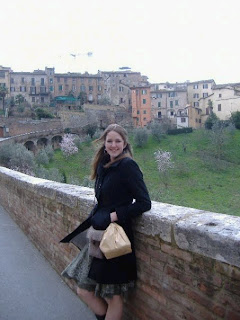 I only spent a week there, but it was long enough to understand that this was a place I wanted to know, to befriend. It was like meeting a famous person, a person I'd heard of but never met, and feeling an affinity...a sense that, under other circumstances, we would become kindred spirits. She would tell me all her secrets, and they would help me understand things about her. I would love her for them. Our friendship would help me understand myself better. It would transform me.
I am determined to live there. It doesn't have to be soon, nor does it have to be forever. But somehow I need to be a part of Italy's story. Italy is already a part of mine.
Everyone falls in love with Italy, to some extent. For some it is a fleeting and faraway crush, a brief fascination. For many the fall is irrevocable and enduring. I have yet to meet a single person who was not at one time intrigued by some aspect of this peerless nation.
Even before the few thrilling days I spent there, I was being primed. I was learning about the Roman Empire and the days of the early church, about the Roman Catholic Church and the Renaissance. I was reading Mandie and the Catacombs, Quo Vadis, An Echo in the Darkness. Middlemarch and A Room With A View and Where Angels Fear to Tread. Under The Tuscan Sun and The Age of Innocence. Roderick Hudson and The Marble Faun. I was watching While You were Sleeping and Return To Me and Gladiator. I was spending my afternoons after school poring over art books in the library: DaVinci and Fra Angelico, Botticelli and Bellini and Caravaggio, Donatello and Giotto and Fra Fillippo Lippi, Titian and Veronese. I was acquiring an idea of Italy.
Then I was there.
I only spent a week there, but it was long enough to understand that this was a place I wanted to know, to befriend. It was like meeting a famous person, a person I'd heard of but never met, and feeling an affinity...a sense that, under other circumstances, we would become kindred spirits. She would tell me all her secrets, and they would help me understand things about her. I would love her for them. Our friendship would help me understand myself better. It would transform me.I am determined to live there. It doesn't have to be soon, nor does it have to be forever. But somehow I need to be a part of Italy's story. Italy is already a part of mine.
Monday, April 12, 2010
hidden will of iron
I am always thrown when relatives express any unsolicited interest in my plans, despite the uncontestable truth that my upbringing should have prepared to me to expect such involvement.
Why do I find it so hard to imagine that my aunts, uncles, cousins, and even siblings, do actually care about me? Why is it so difficult for me to take my family members at face value, rather than reading motivations like pity and a sense of duty into their kindly questions and gentle advice? I guess I am more suspicious and guarded than I give myself credit. And that is saying a lot.
Also, I am private to a fault, particularly in areas of my life where I am unsure of myself. If I am going to go out on a limb, there is no way I'm going to let anyone in on it until I've attained a measure of success. Probably not even then.
Perhaps I've convinced myself that my family truly doesn't care a great deal about the actions I take because I fear the prospect of being a disappointment more than I fear the prospect of being a failure.
Last year I took a personality test in the book Wired That Way and came out very strongly in the "peaceful phlegmatic" camp. One phrase they used to describe this personality group has lingered in my memory. While asserting that peaceful phlegmatics place a high priority on making sure everyone is happy, the book also warned that these outwardly pliable individuals happen to possess a "hidden will of iron."
In a nutshell, this describes my approach to life. I hate when people are unhappy with me, I hate the prospect of disappointing anyone, but there are certain areas of my life where I am brutally inflexible. I will pursue my own dreams. I will try to make these dreams appear as innocuous and palatable as possible in order to make others as happy about them as I am. Or I will simply not share them if I am sure that they will offend. But I will persist in them.
I guess it is this fiercely guarded will of iron that I am nursing when I persuade myself that my family is not truly interested in my plans. I am afraid that if they are truly interested, that if for some reason they are opposed to my will, I will be forced to disappoint them. Much easier to pretend that they are just being polite, and therefore it is okay for me to be casual and evasive in my response.
The book didn't mention cowardice as a side effect of pleaceful phlegmaticism.
Notice, too, the questions I leave pointedly unaddressed. (For example: Am I afraid of talking things out because such discussions might reveal me to be in the wrong? Should I even be pursuing a path that I feel positive my loving devoted family would oppose? Didn't God write a lot about the folly of ignoring advice...of leaning on one's own understanding? Aren't relationships more important than agendas?) Listen to these questions clang against the iron vault of my hidden will.
Why do I find it so hard to imagine that my aunts, uncles, cousins, and even siblings, do actually care about me? Why is it so difficult for me to take my family members at face value, rather than reading motivations like pity and a sense of duty into their kindly questions and gentle advice? I guess I am more suspicious and guarded than I give myself credit. And that is saying a lot.
Also, I am private to a fault, particularly in areas of my life where I am unsure of myself. If I am going to go out on a limb, there is no way I'm going to let anyone in on it until I've attained a measure of success. Probably not even then.
Perhaps I've convinced myself that my family truly doesn't care a great deal about the actions I take because I fear the prospect of being a disappointment more than I fear the prospect of being a failure.
Last year I took a personality test in the book Wired That Way and came out very strongly in the "peaceful phlegmatic" camp. One phrase they used to describe this personality group has lingered in my memory. While asserting that peaceful phlegmatics place a high priority on making sure everyone is happy, the book also warned that these outwardly pliable individuals happen to possess a "hidden will of iron."
In a nutshell, this describes my approach to life. I hate when people are unhappy with me, I hate the prospect of disappointing anyone, but there are certain areas of my life where I am brutally inflexible. I will pursue my own dreams. I will try to make these dreams appear as innocuous and palatable as possible in order to make others as happy about them as I am. Or I will simply not share them if I am sure that they will offend. But I will persist in them.
I guess it is this fiercely guarded will of iron that I am nursing when I persuade myself that my family is not truly interested in my plans. I am afraid that if they are truly interested, that if for some reason they are opposed to my will, I will be forced to disappoint them. Much easier to pretend that they are just being polite, and therefore it is okay for me to be casual and evasive in my response.
The book didn't mention cowardice as a side effect of pleaceful phlegmaticism.
Notice, too, the questions I leave pointedly unaddressed. (For example: Am I afraid of talking things out because such discussions might reveal me to be in the wrong? Should I even be pursuing a path that I feel positive my loving devoted family would oppose? Didn't God write a lot about the folly of ignoring advice...of leaning on one's own understanding? Aren't relationships more important than agendas?) Listen to these questions clang against the iron vault of my hidden will.
Friday, April 09, 2010
let this eye be not folly's loophole
I've been re-reading Marilynne Robinson's Home, and feeling that something about this book is special. For some reason it moves me more deeply than usual.
When I actually took a moment to analyze why this is, I had a revelation. I realized that the difference is not so much in the book itself as it is in my attitude towards it.
Usually when I read a book, my attitude is one of conquest, of entitlement. I'm the conquistador blazing through foreign terrain and seeking to understand it only for my own personal profit. It can be easy for me to emerge from a book having made very little connection with the characters, caring very little about how they end up (or caring only from a scientific distance), and feeling strongly only about how beautifully the author managed to render the scenery. I can draw from it a sense of the picturesque, and perhaps a sweeping overview of the themes that I can, if I desire, apply sweepingly to myself. I can walk away more experienced, perhaps, smarter...but essentially unchanged.
With this book, however, I quickly discover that I am on native soil. It doesn't take long for me to recognize these faces. I am one of them, and that makes all the difference to my posture. I pay each scene, each character, each event the sort of attention (critical and loving) that an insider pays to each landmark or passerby or local occurance. I'm no tourist here, rushing through the highlights of the Baedecker and going my way with only a blur of faces and places lingering in my memory. Rather, these pages turn my gaze both backward and inward, prompt me to pause over memories of the people and places that produced me, and to reflect on my motivations and behavior in both the past and the present.
Embedded in the fictional setting of Gilead, Iowa is a truth I can identify because I have experienced it. And I can let it effect me deeply.
This whole line of thought has me reevaluating the sort of attention I pay to other books. I want to read in order to become a better human--not in order to be regarded as cultured or well-educated. Not to take a little vacation from reality. Not for my own glory or because it simply is the thing to do or because I feel that it will strengthen my morals or broaden my experience. I don't want to be a Cortez of literary frontiers; I don't even want to be a Miss Lavish or an Innocent Abroad.
Books are another sphere in which I can "see in all bodies the beat of spirit," an arena where the "alien hands of love" can touch me if, I let them. Reading opens up yet another place in which I can love my neighbor as myself--where I can learn to be "giver of due regard."
So no more arrogance, entitlement, patronization, generalization as I open each new book.
Instead: humility, teachability, attention, gratitude.
When I actually took a moment to analyze why this is, I had a revelation. I realized that the difference is not so much in the book itself as it is in my attitude towards it.
Usually when I read a book, my attitude is one of conquest, of entitlement. I'm the conquistador blazing through foreign terrain and seeking to understand it only for my own personal profit. It can be easy for me to emerge from a book having made very little connection with the characters, caring very little about how they end up (or caring only from a scientific distance), and feeling strongly only about how beautifully the author managed to render the scenery. I can draw from it a sense of the picturesque, and perhaps a sweeping overview of the themes that I can, if I desire, apply sweepingly to myself. I can walk away more experienced, perhaps, smarter...but essentially unchanged.
With this book, however, I quickly discover that I am on native soil. It doesn't take long for me to recognize these faces. I am one of them, and that makes all the difference to my posture. I pay each scene, each character, each event the sort of attention (critical and loving) that an insider pays to each landmark or passerby or local occurance. I'm no tourist here, rushing through the highlights of the Baedecker and going my way with only a blur of faces and places lingering in my memory. Rather, these pages turn my gaze both backward and inward, prompt me to pause over memories of the people and places that produced me, and to reflect on my motivations and behavior in both the past and the present.
Embedded in the fictional setting of Gilead, Iowa is a truth I can identify because I have experienced it. And I can let it effect me deeply.
This whole line of thought has me reevaluating the sort of attention I pay to other books. I want to read in order to become a better human--not in order to be regarded as cultured or well-educated. Not to take a little vacation from reality. Not for my own glory or because it simply is the thing to do or because I feel that it will strengthen my morals or broaden my experience. I don't want to be a Cortez of literary frontiers; I don't even want to be a Miss Lavish or an Innocent Abroad.
Books are another sphere in which I can "see in all bodies the beat of spirit," an arena where the "alien hands of love" can touch me if, I let them. Reading opens up yet another place in which I can love my neighbor as myself--where I can learn to be "giver of due regard."
So no more arrogance, entitlement, patronization, generalization as I open each new book.
Instead: humility, teachability, attention, gratitude.
Thursday, April 01, 2010
Maundy Thursday
I love the religious calendar. It is as though a bunch of alarm clocks were smuggled into the year, strategically timed to rouse my heart from slumber and open my eyes to the full meaning of my experience.
With every passing year, this song means more for me. Incarnation, Epiphany, Lent, Palm Sunday, Maundy Thursday, Good Friday, Easter, Ascension, Pentecost, and Advent again. This cycle, Christ's cycle, is my cycle, too. Each milestone reminds me of my own experience: new creation, death to self, resurrection, ascension, life eternal. The pattern contains revelation to assure me, promise to thrill me, mystery to keep me reaching.
I look into my heart and count the rings, read the weathers of each particular season: sunshine and rain, draught and flood, harvests abundant and scant. I am consoled to see that, even without my knowledge or desire, each ring came to completion. Each new ring grew wider than the one before.
I think: You are growing.
I may at times feel vulnerable to the elements, at the mercy of the weathers of the world. But then I am reminded that I am a sacred tree, planted beside the living water. My roots tighten their grip. My branches curve up and spread out.
I photosynthesize with zeal.
With every passing year, this song means more for me. Incarnation, Epiphany, Lent, Palm Sunday, Maundy Thursday, Good Friday, Easter, Ascension, Pentecost, and Advent again. This cycle, Christ's cycle, is my cycle, too. Each milestone reminds me of my own experience: new creation, death to self, resurrection, ascension, life eternal. The pattern contains revelation to assure me, promise to thrill me, mystery to keep me reaching.
I look into my heart and count the rings, read the weathers of each particular season: sunshine and rain, draught and flood, harvests abundant and scant. I am consoled to see that, even without my knowledge or desire, each ring came to completion. Each new ring grew wider than the one before.
I think: You are growing.
I may at times feel vulnerable to the elements, at the mercy of the weathers of the world. But then I am reminded that I am a sacred tree, planted beside the living water. My roots tighten their grip. My branches curve up and spread out.
I photosynthesize with zeal.
Monday, March 29, 2010
fry me, sunny side up
Tu Wi's Considers April Sunlight
[Barbara Crooker]
from her copper saucepan, basting the meadow in hollondaise.
Where it drips: buttercups, dandelions, butter & eggs.
Where it splashes: forsythia, daffodils, tulips.
After this long hard winter, I reach out my arms,
lift my face to the sky.
Fry me, sunny side up,
on spring's hot griddle; clarify me, anoint me,
in your lavish lemon light.
[Barbara Crooker]

from her copper saucepan, basting the meadow in hollondaise.
Where it drips: buttercups, dandelions, butter & eggs.
Where it splashes: forsythia, daffodils, tulips.
After this long hard winter, I reach out my arms,
lift my face to the sky.
Fry me, sunny side up,
on spring's hot griddle; clarify me, anoint me,
in your lavish lemon light.
neediness
I want to share exactly how it felt yesterday, to roam an uncharted landscape in a restless sunshine. I want you to partake of Janie's exuberance, as I did, watching her leap from lichened rocks to long-stemmed grasses, snuffle through the wind-wakened cellulite of muddy red puddles, stiffen and prick at the sound of a distant howl.
I want you to feel the strong gentle fingers of the wind rifle through your hair, and the sloppy suction of clay on your tennis shoes, and the pale solar glow warming the backs of your legs. I want you to picture the tiny black flies dancing over every inch of water, and then I want you to zoom out and see the textured earth, hummocks and power lines, trees and grasses, somersaulting down to the skyline.
I want you to know the heady smallness of standing on a mountain-top, drawn to scale, engulfed.
I would even wish for you the satisfaction of scratched ankles, aching muscles, dirt-caked laundry.
I want all of this for you, selfishly, because the only thing that is missing to make my experience complete is human fellowship, and I will not be able to fully enjoy it until I have attempted to share with someone.
I want you to feel the strong gentle fingers of the wind rifle through your hair, and the sloppy suction of clay on your tennis shoes, and the pale solar glow warming the backs of your legs. I want you to picture the tiny black flies dancing over every inch of water, and then I want you to zoom out and see the textured earth, hummocks and power lines, trees and grasses, somersaulting down to the skyline.
I want you to know the heady smallness of standing on a mountain-top, drawn to scale, engulfed.
I would even wish for you the satisfaction of scratched ankles, aching muscles, dirt-caked laundry.
I want all of this for you, selfishly, because the only thing that is missing to make my experience complete is human fellowship, and I will not be able to fully enjoy it until I have attempted to share with someone.
Friday, March 26, 2010
fragments
"I stood there and felt the melancholy / of growing older in such a season"... (Evan Boland)
Growing older in springtime does involve a dimension of melancholy. I am still young, but at the same time I percieve the shadow lengthening behind me where I used to sense only sunshine.
“Youth never sees its shadow till the sun’s about to set: and then you wonder where the person went who you were speaking to in all your thoughts for all those years.” (Marianne Wiggins)
The distance between feeling the melancholy of growing older and seeing that shadow is increasingly short. A degree of circumspection would better befit my behavior than the heedless dithering that has characterized it of late.
Growing older in springtime does involve a dimension of melancholy. I am still young, but at the same time I percieve the shadow lengthening behind me where I used to sense only sunshine.
“Youth never sees its shadow till the sun’s about to set: and then you wonder where the person went who you were speaking to in all your thoughts for all those years.” (Marianne Wiggins)
The distance between feeling the melancholy of growing older and seeing that shadow is increasingly short. A degree of circumspection would better befit my behavior than the heedless dithering that has characterized it of late.
Thursday, March 25, 2010
Nostalgia
When I think of nostalgia, I think of the poem by Emily Dickinson about the certain slant of light. So often the trigger for nostalgia is as simple as that: a slant of light, a waft of fragrance, a familiar melody.
There's a certain slant of light,
On winter afternoons,
That oppresses, like the weight
Of cathedral tunes.
Heavenly hurt it gives us;
We can find no scar,
But internal difference
Where the meanings are.
None may teach it anything,
'Tis the seal, despair,-
An imperial affliction
Sent us of the air.
When it comes, the landscape listens,
Shadows hold their breath;
When it goes, 't is like the distance
On the look of death.
The language Dickinson uses is so powerful that some might object to my labeling it "nostalgic." I would argue that nostalgia and mourning share plenty of common ground. When I feel nostalgic, there is often an element of regret and melancholy, a sense of loss, wistfulness, sentimentality. Similarly, mourning (sorrow over something lost) involves feelings of regret, yearning, and sentimentality. The difference between the two is one of directness. Mourning is always transitive; nostalgia is frequently intransitive. When you mourn, your emotion has a direct object: a clear idea of something or someone that once was there and now is gone. On the other hand, it is possible to feel nostalgic and not even know precisely why. The direct cause can elude you, although you perhaps can link your emotion to the indirect object, which is often its trigger.
In this poem, Emily she isn't speaking about her sorrow over the loss of any tangible thing. She is talking about a slant of light, a familiar enough atmospheric condition that happens on winter afternoons, and about how it makes her feel. How when she sees this slant of light, the injury it gives her is a spiritual affliction, a sense of despair that leaves no outer scar but nevertheless changes the meanings of things for her. It seems to her as though the world is holding its breath, listening. And when it passes, it reminds her of "the distance / on the look of death."
The slant of light is not the cause of her despair. But the sight of it pierces deep to the place where she stores her meanings--the things that are important to her, that help her make sense of the world (memories, for instance)--and casts a painful chill over her spirit.
That is nostalgia. It doesn't always come with such intensity, nor is it always a stirrer of grief. But it always makes internal difference, where our meanings are.
Tuesday, March 23, 2010
I'm ready for a ready heart
I found in this quote the sting of conviction and the relief of enlightenment. Blessed are the meek, indeed.
"Isn't this the simple explanation for our being so heavy-laden, so tired, so overburdened and confused and bitter? We drag around such prodigious loads of resentment and self-assertion. ... Meekness is teachability. It is the readiness to be shown, which includes the readiness to lay down my fixed notions, my objections and 'what ifs' or 'but what abouts,' my certainties about the rightness of what I have always done or thought or said. It is the child's glad 'Show me! Is this the way? Please help me.' It shows in the kind of attention we pay to one another, the tone of voice we use, the facial expression. The weapon of meekness counters all enmity, says author Dietrich Von Hildebrand, with the offer of an unshielded heart." [Elisabeth Elliot]
"Isn't this the simple explanation for our being so heavy-laden, so tired, so overburdened and confused and bitter? We drag around such prodigious loads of resentment and self-assertion. ... Meekness is teachability. It is the readiness to be shown, which includes the readiness to lay down my fixed notions, my objections and 'what ifs' or 'but what abouts,' my certainties about the rightness of what I have always done or thought or said. It is the child's glad 'Show me! Is this the way? Please help me.' It shows in the kind of attention we pay to one another, the tone of voice we use, the facial expression. The weapon of meekness counters all enmity, says author Dietrich Von Hildebrand, with the offer of an unshielded heart." [Elisabeth Elliot]
Monday, March 22, 2010
fancy
The World
I would like to write a poem about the world that has in it
I would like to write a poem about the world that has in it
nothing fancy.
But it seems impossible.
Whatever the subject, the morning sun
glimmers it.
glimmers it.
The tulip feels the heat and flaps its petals open
and becomes a star.
The ants bore into the peony bud and there is the dark
pinprick well of sweetness.
pinprick well of sweetness.
As for the stones on the beach, forget it.
Each one could be set in gold.
So I tried with my eyes shut, but of course the birds
were singing.
And the aspen trees were shaking the sweetest music
out of their leaves.
And that was followed by, guess what, a momentous and
beautiful silence
as comes to all of us, in little earfuls, if we're not too
hurried to hear it.
As for spiders, how the dew hangs in their webs
even if they say nothing, or seem to say nothing.
So fancy is the world, who knows, maybe they sing.
So fancy is the world, who knows, maybe the stars sing too,
and the ants, and the peonies, and the warm stones,
so happy to be where they are, on the beach, instead of being
locked up in gold.
locked up in gold.
-Mary Oliver-
Friday, March 19, 2010
Ah, youth

It's been a joyous day so far. The air is elastic, tingling with spring. I may have been handpicked for trouble by some malignant star lately, but I'm not letting that get me down. After all: I'm juiced up on coffee, sleep, and sunbeams, and my brain is just teeming with hair-brained solutions to every dilemma I face.
Wednesday, March 17, 2010
R.I.P.

LeBaron, Chrysler (1994-2010)
I will miss the way your windshield, with its jagged crack along the length of the dash, shrieked like a kid on a rollercoaster everytime I pushed you upwards of 45 mph.
I will miss how I'd have to turn the wheel ever so slightly to the left in order to drive a straight line.
I will miss that little warning shimmy you'd do if I speeded over 80 mph. Also the way you'd resign to the speed and go straight as an arrow at 95.
We've made so many memories, LeBaron. Like the time when it was snowing so hard, and we catapulted into a ditch only a half an hour from home, and you kept me warm while we waited for the tow truck. Or on a particular visit to Canada, when you took the brunt of some mean off-the-cuff poems, created by me and my sister. (I'm sorry. We were very bored.) Remember Black Thursday? You were so great, especially last year, when you submitted graciously between retail destinations to gallonful doses of cold water in your radiator . Although you suffered from turn signal failure, you never let it stop you. The indignity of my litter--mugs and popcans, scraps of paper, ketchup packets--you tolerated without complaint.
My driveway was so cruel but you weathered it daily, multiple times even, with bounce and aplomb, shooting all those pebbles back into the road (zing!) with disdain.
You carried me to Michigan and back four times, to Canada and back once. We've visited South Carolina and Atlanta.
I only regret that I put off all the other road trips we'd idly planned until it was too late.
The last image that I have of you--your unlit headlights facing me in the chilly gray afternoon as you were towed onto Scenic Highway--haunts me still. I didn't know I was saying goodbye.
I didn't deserve you, LeBaron.
Rest in peace.
I will miss the way your windshield, with its jagged crack along the length of the dash, shrieked like a kid on a rollercoaster everytime I pushed you upwards of 45 mph.
I will miss how I'd have to turn the wheel ever so slightly to the left in order to drive a straight line.
I will miss that little warning shimmy you'd do if I speeded over 80 mph. Also the way you'd resign to the speed and go straight as an arrow at 95.
We've made so many memories, LeBaron. Like the time when it was snowing so hard, and we catapulted into a ditch only a half an hour from home, and you kept me warm while we waited for the tow truck. Or on a particular visit to Canada, when you took the brunt of some mean off-the-cuff poems, created by me and my sister. (I'm sorry. We were very bored.) Remember Black Thursday? You were so great, especially last year, when you submitted graciously between retail destinations to gallonful doses of cold water in your radiator . Although you suffered from turn signal failure, you never let it stop you. The indignity of my litter--mugs and popcans, scraps of paper, ketchup packets--you tolerated without complaint.
My driveway was so cruel but you weathered it daily, multiple times even, with bounce and aplomb, shooting all those pebbles back into the road (zing!) with disdain.
You carried me to Michigan and back four times, to Canada and back once. We've visited South Carolina and Atlanta.
I only regret that I put off all the other road trips we'd idly planned until it was too late.
The last image that I have of you--your unlit headlights facing me in the chilly gray afternoon as you were towed onto Scenic Highway--haunts me still. I didn't know I was saying goodbye.
I didn't deserve you, LeBaron.
Rest in peace.
muddles
"Take an old man's word; there's nothing worse than a muddle in all the world. It's easy to face Death and Fate, the things that sound so dreadful. It is on my muddles that I look back with horror--on the things that I might have avoided. We can help one another but little. I used to think I could teach young people the whole of life, but I know better now, and all my teaching of George has come down to this: beware of muddle. ...Though life is very glorious, it is difficult. ...'Life' wrote a friend of mine, 'is a public performance on the violin, in which you must learn the instrument as you go along.' I think he puts it well. Man has to pick up the use of his functions as he goes along--especially the function of Love."
[A Room With A View]
Monday, March 15, 2010
See Jan(ie) Run. Laugh Jan(ie), Laugh.
Today didn't start off very well.
I had car trouble. I was nearly late for work. The bathrooms and lobbies that had been so starched and clean when I left them Friday looked positively hung-over when I arrived this morning. A bathroom spray nozzle rewarded my efforts to clean out a shower stall by spraying foamy green cleaning chemical all down the front of my jeans. I still don't know what caused the excruciating charlie horse in the fourth toe of my right foot a few moments later. My workers (bless them) were too cheerful and peppy to suit my cranky frame of mind.
But why am I even mentioning this? All of that misery vanished at the sight of my dog DOING A SOMERSAULT through the leaf-strewn grass of my front yard in her unbridled zeal to greet me: hunched, mopey me with that huge invisible chip on my shoulder that she didn't perceive, thank goodness. The fervent joy of her gallop was contagious--I swear, she was laughing. Just picture how, in the breeze of her approach, her ears flapped and tongue lolled with goofy dignity. Try not to smile. The way she plopped in the grass at my feet and craned her head back for a better view while her entire hind end waggled in the grass had me feeling like royalty.
Now here I sit in my snug silent living room, sipping tea and smiling. Janie is curled up at my feet with a spoonful of crunchy peanut butter. I can hardly remember how grumpy feels. The day may not be young, but it is aged to a tranquil mellow that suits me just fine. Time for me to read some poems.
I had car trouble. I was nearly late for work. The bathrooms and lobbies that had been so starched and clean when I left them Friday looked positively hung-over when I arrived this morning. A bathroom spray nozzle rewarded my efforts to clean out a shower stall by spraying foamy green cleaning chemical all down the front of my jeans. I still don't know what caused the excruciating charlie horse in the fourth toe of my right foot a few moments later. My workers (bless them) were too cheerful and peppy to suit my cranky frame of mind.
But why am I even mentioning this? All of that misery vanished at the sight of my dog DOING A SOMERSAULT through the leaf-strewn grass of my front yard in her unbridled zeal to greet me: hunched, mopey me with that huge invisible chip on my shoulder that she didn't perceive, thank goodness. The fervent joy of her gallop was contagious--I swear, she was laughing. Just picture how, in the breeze of her approach, her ears flapped and tongue lolled with goofy dignity. Try not to smile. The way she plopped in the grass at my feet and craned her head back for a better view while her entire hind end waggled in the grass had me feeling like royalty.
Now here I sit in my snug silent living room, sipping tea and smiling. Janie is curled up at my feet with a spoonful of crunchy peanut butter. I can hardly remember how grumpy feels. The day may not be young, but it is aged to a tranquil mellow that suits me just fine. Time for me to read some poems.
Friday, March 12, 2010
freewriting
I've never much enjoyed the discipline of "freewriting."
In elementary school and middle school, my teachers would scold me for my frequent anguished pauses during our sixty-second freewrite sessions. "Abby, the point is not to get it perfect. Don't worry about spell checks or revision. That comes later. Just get what you're feeling onto the paper, okay?"
So I'd sit there in a paralysis of possibilities, and resort at last to writing lines. "I will not revise. I will not spell check. I will write what I feel. I will not revise. I will not spell check..." The buzzer would go off and I'd turn the paper in with a sense of mingled relief and failure, imagining the scorn with which my teacher would read it later: "Poor girl's a parrot. No originality at all."
Those paralyzed sessions at my desk were prophecies. Little did I know then how symptomatic my revulsion to freewriting was. The affliction to which it pointed was far more sinister than mere "lack of originality." It was lack of artlessness. It was crippling inhibition.
My super-ego constantly played Charlotte Bartlett (hypersensitive, controlling, and pathetic) to my ego's baffled and hesitatingly compliant Lucy Honeychurch. As I'd put the pencil to the page and initiate a clumsy and unpolished sentence ("indelicate" perhaps, but "at the same time, beautiful"), the pinched inner voice would gasp in horror and squeak, "Oh, but that won't do. I'd never forgive myself if I permitted you to commit this act of indiscretion. Best to phrase it this way..."
I could not express freely "what I felt" (as my Mr. Beebe or Mr. Emerson of a teacher urged) because of my mind's spinsterly chaperone. Nor could I proceed with the caution she required because of the time restraint. There was nothing to do, then, but to take refuge in parrotry.
That tension has only intensified as I've grown. In my relationships, in my writing, in my reactions to events, I constantly feel my heart rise to express how I feel--the restraining hand of social mores siezing it--and my lips spilling out some dull but safe Cecil Vyse of a cliche in response.
This cycle is wrong. It is false. I hate it.
I want my expressions of self to be beautiful, even if they are indelicate. I want to know what it's like to freewrite my feelings.
I want George Emerson. I want a room with a view.
In elementary school and middle school, my teachers would scold me for my frequent anguished pauses during our sixty-second freewrite sessions. "Abby, the point is not to get it perfect. Don't worry about spell checks or revision. That comes later. Just get what you're feeling onto the paper, okay?"
So I'd sit there in a paralysis of possibilities, and resort at last to writing lines. "I will not revise. I will not spell check. I will write what I feel. I will not revise. I will not spell check..." The buzzer would go off and I'd turn the paper in with a sense of mingled relief and failure, imagining the scorn with which my teacher would read it later: "Poor girl's a parrot. No originality at all."
Those paralyzed sessions at my desk were prophecies. Little did I know then how symptomatic my revulsion to freewriting was. The affliction to which it pointed was far more sinister than mere "lack of originality." It was lack of artlessness. It was crippling inhibition.
My super-ego constantly played Charlotte Bartlett (hypersensitive, controlling, and pathetic) to my ego's baffled and hesitatingly compliant Lucy Honeychurch. As I'd put the pencil to the page and initiate a clumsy and unpolished sentence ("indelicate" perhaps, but "at the same time, beautiful"), the pinched inner voice would gasp in horror and squeak, "Oh, but that won't do. I'd never forgive myself if I permitted you to commit this act of indiscretion. Best to phrase it this way..."
I could not express freely "what I felt" (as my Mr. Beebe or Mr. Emerson of a teacher urged) because of my mind's spinsterly chaperone. Nor could I proceed with the caution she required because of the time restraint. There was nothing to do, then, but to take refuge in parrotry.
That tension has only intensified as I've grown. In my relationships, in my writing, in my reactions to events, I constantly feel my heart rise to express how I feel--the restraining hand of social mores siezing it--and my lips spilling out some dull but safe Cecil Vyse of a cliche in response.
This cycle is wrong. It is false. I hate it.
I want my expressions of self to be beautiful, even if they are indelicate. I want to know what it's like to freewrite my feelings.
I want George Emerson. I want a room with a view.
Friday, March 05, 2010

Thursday, March 04, 2010
What was the subconscious impulse that prompted the circuits in my skull to begin pulsating to the nauseatingly cheesy rhythm of I'll be your wish I'll be your dream I'll be your fantasy? For whatever reason, when I staggered into the kitchen this morning to make myself some coffee, Savage Garden was in my head.
I wonder if King David ever woke up to the Shema Yisrael ringing in his ears. His bodyguards may have heard him muttering it absently as he paced the Jerusalem battlements. Homeric storytellers probably lived most of their lives with fragments of the Illiad and Odyssey running on repeat through their brains. ("Honey, I just can't get that 'rosy fingered dawn' phrase out of my head today!") And so on.
The brain's habit of latching onto a memorized piece has probably initiated countless conversations throughout history that resemble the one I had with my housemate a few hours ago. Conversations starting with "Guess what I've had in my head ever since I woke up?"and concluding with a joint performance of the particular bit of human genius under discussion.
Maybe it's a rudimentary way of preserving and transmitting our cultural heritage. In which case, I am not sure how I feel on this particular day about my brain's selectivity. Yikes.
At any rate, it's fun to think about...and gives my psyche a pleasant break from the song that feels like it will be in my head forever ("until the sky falls down on me").
I wonder if King David ever woke up to the Shema Yisrael ringing in his ears. His bodyguards may have heard him muttering it absently as he paced the Jerusalem battlements. Homeric storytellers probably lived most of their lives with fragments of the Illiad and Odyssey running on repeat through their brains. ("Honey, I just can't get that 'rosy fingered dawn' phrase out of my head today!") And so on.
The brain's habit of latching onto a memorized piece has probably initiated countless conversations throughout history that resemble the one I had with my housemate a few hours ago. Conversations starting with "Guess what I've had in my head ever since I woke up?"and concluding with a joint performance of the particular bit of human genius under discussion.
Maybe it's a rudimentary way of preserving and transmitting our cultural heritage. In which case, I am not sure how I feel on this particular day about my brain's selectivity. Yikes.
At any rate, it's fun to think about...and gives my psyche a pleasant break from the song that feels like it will be in my head forever ("until the sky falls down on me").
Monday, March 01, 2010
I'm sitting in my living room, soaking up the silence and sipping pop after a long and productive day. The lovely thing about my job is that it affords me one tangible arena where I can work, see immediate results, and go home feeling satisfied and useful. I ache to feel that way in every area of my life, but instead feel inadequate or even downright burdensome. The knowledge that I cannot handle everything on my own gnaws at me constantly. I never realized before how much I hate to ask for help, how much of my life revolves around my delusions of autonomy. And oh, what delusions they are.
I survey my many recurring messes. I wrangle with uncertainties about housing and schooling and transportation and finances.
And I realize that really there's nothing for it but to summon my sense of humor and eat my loaded slice of humble pie with wry but hearty laughter.
I survey my many recurring messes. I wrangle with uncertainties about housing and schooling and transportation and finances.
And I realize that really there's nothing for it but to summon my sense of humor and eat my loaded slice of humble pie with wry but hearty laughter.
Thursday, February 25, 2010
Hey there
I continue to revel in the unexpected inner brightness that had me up and alert at 5 am this morning and has not dropped me yet.
The first hour of my morning I spent snuggled in my bedroom beneath the warm halo of light from my bedside lamp, reading "Emily Climbs" and drinking a mug of Starbucks Christmas blend (rediscovered in the depths of my freezer a few days ago and hoarded until just such an occasion). Or rather rereading "Emily Climbs" and reading unexpected little character sketches of my younger self in those familiar pages. Younger Me kept popping up as I read: Younger Me with her huge round glasses and long bushy hair, reading late at night by the crack of light from the bedroom door, moony and clueless, prone (like Emily) to italics and wordspendthriftery, earnestly bent in her most secret heart on pursuing the "Alpine Path." Crushing rather shamelessly on Teddy Kent (who remains a dreamboat to this very day).
After that pleasant little reunion, I just had to grin at my not-so-grown-up-self in the mirror later that hour. The reflection that greeted me--glasses winking in the light, long brown hair disheveled--was oh so friendly and familiar.
Bless her little daydreamy heart.

The first hour of my morning I spent snuggled in my bedroom beneath the warm halo of light from my bedside lamp, reading "Emily Climbs" and drinking a mug of Starbucks Christmas blend (rediscovered in the depths of my freezer a few days ago and hoarded until just such an occasion). Or rather rereading "Emily Climbs" and reading unexpected little character sketches of my younger self in those familiar pages. Younger Me kept popping up as I read: Younger Me with her huge round glasses and long bushy hair, reading late at night by the crack of light from the bedroom door, moony and clueless, prone (like Emily) to italics and wordspendthriftery, earnestly bent in her most secret heart on pursuing the "Alpine Path." Crushing rather shamelessly on Teddy Kent (who remains a dreamboat to this very day).
After that pleasant little reunion, I just had to grin at my not-so-grown-up-self in the mirror later that hour. The reflection that greeted me--glasses winking in the light, long brown hair disheveled--was oh so friendly and familiar.
Bless her little daydreamy heart.
Friday, February 19, 2010
my curvaceous moment
Every time I venture outside (usually carrying a harvest of overripe trashbags, their plastic stems clenched in my cold hands), my heart reacts to today's beauty the way I've seen the thick patch of ice on the cement beneath my feet respond to sunlight.
You've seen what ice does when stricken by light. That is how it is for me this afternoon: that inexplicable arresting shimmy of color and glow that flares in my chest at the moment of kindling and then holds, steady and alive, until the attention wavers or the sun departs.
It's an ovation inevitable as a reflex, as natural and irrepressible as ice in the sun. As vital and insignificant as that.
Remember how Mary Oliver speaks of words as "the responses to the thousand curvaceous moments"? I'm pretty sure that this is the sort of thing she had in mind.
You've seen what ice does when stricken by light. That is how it is for me this afternoon: that inexplicable arresting shimmy of color and glow that flares in my chest at the moment of kindling and then holds, steady and alive, until the attention wavers or the sun departs.
It's an ovation inevitable as a reflex, as natural and irrepressible as ice in the sun. As vital and insignificant as that.
Remember how Mary Oliver speaks of words as "the responses to the thousand curvaceous moments"? I'm pretty sure that this is the sort of thing she had in mind.
Wednesday, February 17, 2010
remembering
One of the aspects of my humanity I take most for granted is my ability to remember. What a marvel it is that my 5'11'' 165 lb frame manages to find storage space for my life's chronicles: moment of birth till the constant succession of "nows" that are steadily elapsing. And beyond, if I think about it more deeply.
Some of these records I will never be able to visit: the ones the precede the formation of my words and ideas, like my birth and my first few years of life. But they are there, I am told, making frequent imperceptible contributions to the way I think and behave, the personality I develop.
They exist alongside the records that I do have access to, the ones that warp and blur as they are transmuted through Time's altering medium, continuing to exist only at the cost of their integrity and completeness. The ones that take me by surprise--evoked by some external stimulus: a slant of light, a certain fragrance, a familiar name uttered in a crowd. Also, the ones that are deliberately trotted out in the context of friendship or family: the inside joke, the wistful anecdote, the enthusiastic "I remember when...!"
I have memories that predate my own existence, memories that have been transmitted to me by parents and loved ones and teachers. These include stories about my ancestry, or about world events dating back to Adam and Eve. I carry around with me a memory of the time poor King Harold got an arrow in the eye at the Battle of Hastings, and a memory of the time my Opa jumped ship and became an illegal alien on American soil.
As I go about my daily routines, I am constantly sifting through these memories, being entertained by them, dredging them up to help me cope with all brands of situations, reliving the wafts of emotion that they diffuse into my inner atmosphere. It's miraculous. These fragile, surreal memories are a part of my composition and function as much as veins and arteries, bones and organs--an idea that disturbs me. I take measures to protect them, embalming them in joural entries and blogposts, conveying them to friends and family members for safekeeping. Yet all the while, I am aware that these measures also inevitably distort and weaken them.
Of course, the poverty of my own articulation strikes me when I am reminded (ha!) of these words by Marilynne Robinson in Gilead: "This life has its own mortal loveliness. And memory is not strictly mortal in its nature, either. It is a strange thing, after all, to be able to return to a moment, when it can hardly be said to have any reality at all, even in its passing. A moment is such a slight thing, I mean, that its abiding is a most gracious reprieve."
Also, this quote from Harriet Doerr's Stones For Ibarra. "Memories are like corks left out of bottles. They swell. They no longer fit."
And yet again, I am brought back to considering the fragility and finity of my human existence. Also, its resilience, its persistence. Till the gossamer thread you fling catch somewhere, O my soul.
Some of these records I will never be able to visit: the ones the precede the formation of my words and ideas, like my birth and my first few years of life. But they are there, I am told, making frequent imperceptible contributions to the way I think and behave, the personality I develop.
They exist alongside the records that I do have access to, the ones that warp and blur as they are transmuted through Time's altering medium, continuing to exist only at the cost of their integrity and completeness. The ones that take me by surprise--evoked by some external stimulus: a slant of light, a certain fragrance, a familiar name uttered in a crowd. Also, the ones that are deliberately trotted out in the context of friendship or family: the inside joke, the wistful anecdote, the enthusiastic "I remember when...!"
I have memories that predate my own existence, memories that have been transmitted to me by parents and loved ones and teachers. These include stories about my ancestry, or about world events dating back to Adam and Eve. I carry around with me a memory of the time poor King Harold got an arrow in the eye at the Battle of Hastings, and a memory of the time my Opa jumped ship and became an illegal alien on American soil.
As I go about my daily routines, I am constantly sifting through these memories, being entertained by them, dredging them up to help me cope with all brands of situations, reliving the wafts of emotion that they diffuse into my inner atmosphere. It's miraculous. These fragile, surreal memories are a part of my composition and function as much as veins and arteries, bones and organs--an idea that disturbs me. I take measures to protect them, embalming them in joural entries and blogposts, conveying them to friends and family members for safekeeping. Yet all the while, I am aware that these measures also inevitably distort and weaken them.
Of course, the poverty of my own articulation strikes me when I am reminded (ha!) of these words by Marilynne Robinson in Gilead: "This life has its own mortal loveliness. And memory is not strictly mortal in its nature, either. It is a strange thing, after all, to be able to return to a moment, when it can hardly be said to have any reality at all, even in its passing. A moment is such a slight thing, I mean, that its abiding is a most gracious reprieve."
Also, this quote from Harriet Doerr's Stones For Ibarra. "Memories are like corks left out of bottles. They swell. They no longer fit."
And yet again, I am brought back to considering the fragility and finity of my human existence. Also, its resilience, its persistence. Till the gossamer thread you fling catch somewhere, O my soul.
Tuesday, February 16, 2010
I love Faulkner. Without my conscious involvement, he guides my mind to make associative connections that gradually expose all the textures and emotions of the story he is telling. I start reading, absorbing, not quite "getting" the words...and then suddenly it is there: I know what is going on, and I am personally involved, intimately concerned with the characters.
How is he able to work that kind of magic with the same old words we use every day? It thrills me.
How is he able to work that kind of magic with the same old words we use every day? It thrills me.
Wednesday, February 10, 2010
comfort food
I am always in the mood for Madeleine L'Engle.
Yesterday I was feeling crabby and tired. My work day had been trying, and I'd parted from a significant amount of money that evening when I ransomed my car from the auto shop. Janie had shredded one of my Buechner books and torn the binding off my current journal by the time I returned home. Our kitchen was a mess, and our fitful heater was back on its emergency setting and doing a less than stellar job of warming the drafty house. When the house is a mess it seems colder anyway, because it lacks the cozy factor.
All of these conditions combined to bring out the worst in me. To combat them, I knew I needed a reliable fix-me-up, and fast.
So: I fixed a pot of coffee and some stovetop cream of wheat, and I picked up Meet the Austins by Madeleine L'Engle: the comfort food of literature.
It is rich, harboring all the "sound and fury" of a teeming household: rowdy dinners, tumbly bedtimes, homework, chores, television, bicycles. All of this homespun content is handled deftly, in a way that reveals good parenting and childhood epiphanies while managing to avoid the trap of sanctimoniousness or sentimentality, most of the time. It is utterly engrossing without relying on glamor or spectacle. And it has moments of hilarity.
Basically, it reminds me of all the reasons being a human being is so wonderful: fellowship, family, creature comforts, laughter, engaging with life and death and beauty and pain in the setting of ordinary life.
It was the novel version of this poem by Barbara Crooker:
Yesterday I was feeling crabby and tired. My work day had been trying, and I'd parted from a significant amount of money that evening when I ransomed my car from the auto shop. Janie had shredded one of my Buechner books and torn the binding off my current journal by the time I returned home. Our kitchen was a mess, and our fitful heater was back on its emergency setting and doing a less than stellar job of warming the drafty house. When the house is a mess it seems colder anyway, because it lacks the cozy factor.
All of these conditions combined to bring out the worst in me. To combat them, I knew I needed a reliable fix-me-up, and fast.
So: I fixed a pot of coffee and some stovetop cream of wheat, and I picked up Meet the Austins by Madeleine L'Engle: the comfort food of literature.
It is rich, harboring all the "sound and fury" of a teeming household: rowdy dinners, tumbly bedtimes, homework, chores, television, bicycles. All of this homespun content is handled deftly, in a way that reveals good parenting and childhood epiphanies while managing to avoid the trap of sanctimoniousness or sentimentality, most of the time. It is utterly engrossing without relying on glamor or spectacle. And it has moments of hilarity.
Basically, it reminds me of all the reasons being a human being is so wonderful: fellowship, family, creature comforts, laughter, engaging with life and death and beauty and pain in the setting of ordinary life.
It was the novel version of this poem by Barbara Crooker:
Ordinary Life
This was a day when nothing happened,
the children went off to school
without a murmur, remembering
their books, lunches, gloves.
All morning, the baby and I built block stacks
in the squares of light on the floor.
And lunch blended into naptime,
I cleaned out kitchen cupboards,
one of those jobs that never gets done,
then sat in a circle of sunlight
and drank ginger tea,
watched the birds at the feeder
jostle over lunch’s little scraps.
A pheasant strutted from the hedgerow,
preened and flashed his jeweled head.
Now a chicken roasts in the pan,
and the children return,
the murmur of their stories dappling the air.
I peel carrots and potatoes without paring my thumb.
We listen together for your wheels on the drive.
Grace before bread.
And at the table, actual conversation,
no bickering or pokes.
And then, the drift into homework.
The baby goes to his cars, drives them
along the sofa’s ridges and hills.
Leaning by the counter, we steal a long slow kiss,
tasting of coffee and cream.
The chicken’s diminished to skin & skeleton,
the moon to a comma, a sliver of white,
but this has been a day of grace
in the dead of winter,
the hard knuckle of the year,
a day that unwrapped itself
like an unexpected gift,
and the stars turn on,
order themselves
into the winter night.
Now, don't you feel good?
Tuesday, February 09, 2010
These days,
I am...
1. Learning Italian! Thanks to a generous loan of some audio CDs and workbooks from Vowsh, I have a plan that will get me here all the sooner. Rolling basic phrases off my tongue makes this treasured aspiration seem so much more tangible and near.

http://www.flickr.com/photos/cgoulao/3594151487/
1. Learning Italian! Thanks to a generous loan of some audio CDs and workbooks from Vowsh, I have a plan that will get me here all the sooner. Rolling basic phrases off my tongue makes this treasured aspiration seem so much more tangible and near.
http://www.flickr.com/photos/cgoulao/3594151487/
2. Laying the groundwork for my transfer, hopefully this summer, to a less expensive school where I can complete my degree and get off this mountain. It may not be THE wisest move, but I'm standing by it. Any change is improvement, at this point--I'm that restless.
3. Reading a book a week. So far, since January, I've knocked out The Brothers Karamazov, The Whimsical Christian, The Power and the Glory, Auralia's Colors, Consider This Senora, and Ethan Frome. This practice has done me so much good already, stimulating my mind and heart. Reminding me of important things. Holding me back in the best sense possible.
Lately--in case you haven't already sensed this--I've been feeling like a bottled-up reservoir of recklessness, corked by coffee and routine and my own harassed super-ego. Hopefully doing these things will take the edge off of my fretfulness.
At any rate, they are making me feel a bit less adrift in my own life.
Thursday, February 04, 2010
Thursday. My haggard mind is doing its best this morning, but keeps losing focus. The dense fog cosying around my psyche is unsettling. I cannot count the number of times I've found myself standing slackly in the middle of a room, or regarding a paper towel dispenser with almost utter blankness. "Almost utter blankness" is so much worse than "utter blankness." It's that niggling tooth, that word on the tip of the tongue, that vague deja-vu sensation all rolled into a feeling that is distinctly less than the sum of its parts.
I finished reading Greene's "The Power and the Glory" yesterday, and have been gnawing on it in my mind ever since. The priest even made it into my dreams last night, begging me for a place to stay the night. I was in character as Sara, the protagonist of Harriet Doerr's "Consider This, Signora," and was very afraid that my ex would appear and get the wrong impression, especially if he saw the wine I was thoughtfully procuring for my fugitive. For some reason it never entered my mind to fear the wrath of the lieutenant dogging my winebibbing refugee.
All dreaming aside, it was a book brutally faithful to portraying the dark side of the glamor of the Christian faith (the side nearer to apostasy than hypocrisy), and to revealing how the dark side is often, in the that paradoxical cliche, closer to the light than the glamorous side (which is nearer to hypocrisy than apostasy). The priest experiences a terrible fall from grace, finds himself both metaphorically and literally in the same camp as the publicans and sinners, and is forced to recognize the crippling extent of his depravity. It contrasts the petty compromises and complacencies of his prior comfortable existence to the state of mortal sin--drankenness and fornication--that shadows his current existence. In his journey down the slippery slope, the father learns how to love by learning more and more personally about the nature of sin. While he never overcomes his terror of death, he at length does choose it over the safety and hypocrisy of life in a new country.
The novel reminded me that the most important thing in life is to strive after holiness, even though that path is never the easy one. Even though the choices that face me will often seem small and innocuous enough in themselves, whenever I choose the lesser good I am choosing wrongly.
And when I fail (as inevitably I will), the novel reminded me that the plan and providence of God are much vaster than I can dream, and will make everything right in the end.
It was the most discouraging bit of encouragement I have read in a very long time.
I finished reading Greene's "The Power and the Glory" yesterday, and have been gnawing on it in my mind ever since. The priest even made it into my dreams last night, begging me for a place to stay the night. I was in character as Sara, the protagonist of Harriet Doerr's "Consider This, Signora," and was very afraid that my ex would appear and get the wrong impression, especially if he saw the wine I was thoughtfully procuring for my fugitive. For some reason it never entered my mind to fear the wrath of the lieutenant dogging my winebibbing refugee.
All dreaming aside, it was a book brutally faithful to portraying the dark side of the glamor of the Christian faith (the side nearer to apostasy than hypocrisy), and to revealing how the dark side is often, in the that paradoxical cliche, closer to the light than the glamorous side (which is nearer to hypocrisy than apostasy). The priest experiences a terrible fall from grace, finds himself both metaphorically and literally in the same camp as the publicans and sinners, and is forced to recognize the crippling extent of his depravity. It contrasts the petty compromises and complacencies of his prior comfortable existence to the state of mortal sin--drankenness and fornication--that shadows his current existence. In his journey down the slippery slope, the father learns how to love by learning more and more personally about the nature of sin. While he never overcomes his terror of death, he at length does choose it over the safety and hypocrisy of life in a new country.
The novel reminded me that the most important thing in life is to strive after holiness, even though that path is never the easy one. Even though the choices that face me will often seem small and innocuous enough in themselves, whenever I choose the lesser good I am choosing wrongly.
And when I fail (as inevitably I will), the novel reminded me that the plan and providence of God are much vaster than I can dream, and will make everything right in the end.
It was the most discouraging bit of encouragement I have read in a very long time.
Tuesday, February 02, 2010
"Waste"
I know a man who loved his bird so much
He paid a tidy fortune for its cage.
Why is my regret for Juliet
So different from the way I feel about the way this parrot died,
Poisoned by the toxic grain of costly bars?
I can see the humor in the stunts Death pulls
So long as they are distant from myself.
Until I see the man who stares,
He paid a tidy fortune for its cage.
Why is my regret for Juliet
So different from the way I feel about the way this parrot died,
Poisoned by the toxic grain of costly bars?
I can see the humor in the stunts Death pulls
So long as they are distant from myself.
Until I see the man who stares,
guilt-wracked as Juliet, upon
The lifeless fruit of his propitious planning.
Monday, February 01, 2010
weekend
Last Friday, yet another snowstorm descended upon the area that Al Roker has designated "my neck of the woods." Earlier that morning, I had skipped out of my front door wearing only a light spring fleece over my short sleeved shirt, expecting yet another day of unseemly warmth. Three hours later, my boss was shooing me back to the shelter of home, where I watched out the window as God shook snow over tree limbs and shingles, smoothed the knotted ridges of the tire-scarred driveway, and delighted my mind with notions of angels.
Over the course of the ensuing snowbound weekend, I did my inner compass proud and never once got lost during my frequent rambles through the transfigured woods and trails--unless, that is, you count getting lost in thought, in which case I was jubilantly adrift for hours at a stretch. I firmly believe that getting lost is the best way to know your way around a territory, whether the terrrain you cover be geographical or intellectual. The past few days of wondering through the weathers of my inner wilderness have been quite productive, cartographically speaking. I covered a lot of ground, and always found my way home by the time I'd curled my fingers around a hot ceramic mug and made small talk with the nearest house mate.
Never underestimate the transformative power of a winter snow.
Over the course of the ensuing snowbound weekend, I did my inner compass proud and never once got lost during my frequent rambles through the transfigured woods and trails--unless, that is, you count getting lost in thought, in which case I was jubilantly adrift for hours at a stretch. I firmly believe that getting lost is the best way to know your way around a territory, whether the terrrain you cover be geographical or intellectual. The past few days of wondering through the weathers of my inner wilderness have been quite productive, cartographically speaking. I covered a lot of ground, and always found my way home by the time I'd curled my fingers around a hot ceramic mug and made small talk with the nearest house mate.
Never underestimate the transformative power of a winter snow.
Tuesday, January 26, 2010
Face it: Art is everywhere. Everywhere is Art.
There are several little areas on campus, rooms less traveled, that have been decorated with posters in an effort to neutralize the ugly nakedness of cinderblock and the desolate lack of furnishings.
When I pass through one of these small holdouts, I find myself in the crosshairs of a mute conversation between a soulfully glossy Elvis Presley and a shaggily somber John Lennon. John Coltrane, eyes closed, leaning back with his lips to the mouthpiece of his gleaming saxophone, ignores my intrusion. The Beatles stride across Abbey Road in their bellbottomed suits towards the abstract landscape of a guitar chord guide, which must be traversed before they can arrive at the juicy psychadelic explosion of color that is Sgt. Pepper's Lonely Hearts Club Band. Louis Armstrong's eyes roll up from the floor. He is still focused on pumping air into that trumpet as my shadow flits over his felled portrait.
I'll tell you why this quiet little room makes my skin tingle.
In the medium of the presence created by all those faces is rendered an intangible portrait of the person who purchased them and puttied them to the wall. By appropriating these posters, this person announced her personality. She gave it a certain life of its own, detached from her physical being. You might say that she created a spirit and housed it.
The faces of Elvis and the Beatles have become the faces of Rock and Roll, just as the faces of Louis Armstrong and John Coltrane have become the faces of Jazz. Altogether, these faces paint a portrait of the face of Music, an image that is dated like a Rembrandt self-portrait: Music at a certain age, in a certain lighting, with a certain backdrop.
That is why my skin tingles. I step through that door. There is the face of the anonymous person who decorated the walls. The face of Music. My own astonished face.
Whose personality are we announcing?
When I pass through one of these small holdouts, I find myself in the crosshairs of a mute conversation between a soulfully glossy Elvis Presley and a shaggily somber John Lennon. John Coltrane, eyes closed, leaning back with his lips to the mouthpiece of his gleaming saxophone, ignores my intrusion. The Beatles stride across Abbey Road in their bellbottomed suits towards the abstract landscape of a guitar chord guide, which must be traversed before they can arrive at the juicy psychadelic explosion of color that is Sgt. Pepper's Lonely Hearts Club Band. Louis Armstrong's eyes roll up from the floor. He is still focused on pumping air into that trumpet as my shadow flits over his felled portrait.
I'll tell you why this quiet little room makes my skin tingle.
In the medium of the presence created by all those faces is rendered an intangible portrait of the person who purchased them and puttied them to the wall. By appropriating these posters, this person announced her personality. She gave it a certain life of its own, detached from her physical being. You might say that she created a spirit and housed it.
The faces of Elvis and the Beatles have become the faces of Rock and Roll, just as the faces of Louis Armstrong and John Coltrane have become the faces of Jazz. Altogether, these faces paint a portrait of the face of Music, an image that is dated like a Rembrandt self-portrait: Music at a certain age, in a certain lighting, with a certain backdrop.
That is why my skin tingles. I step through that door. There is the face of the anonymous person who decorated the walls. The face of Music. My own astonished face.
Whose personality are we announcing?
Monday, January 25, 2010
glimpse
It's my lunch hour, and I am listening to Yo Yo Ma's "Gabriel's Oboe" beneath the vivid yellow smiley face beaming down at me from its post-it perch amidst the scribbled notes that adorn my computer. This office would make a prime candidate for an "I SPY" book, if only I assembled its contents into rhyme.
I spy three mugs, a blue trash can,
A smudged coffeemaker whose name is "Stan,"
A flower vase, bottle of glue,
A toilet plunger and fire extinguisher, too!
A stuffed dog o'erlooking a vase of flowers,
Two stubborn clocks that won't agree on the hours.
Of course, the ditty could go on and on. Markers, pens, and pushpins, broken vacuums, torn paper snowflakes, outdated Bagpipe issues, beheaded squeegees, cans of cleaning supplies, a butter knife, trashcan liners.
And always, always, the incessent drone that buzzes from the utilities closet in the wall. I like to fancy that this closet is the place where every swallowed complaint comes to dwell. Its tireless groan is the audible manifestation of all the unvoiced weariness of every bored student, every grudging laborer. By seeing it in this light, I can train myself to enjoy an otherwise exasperating sound effect.
(Yes: enjoy. As a supervisor of a janitorial labor force, I have been programmed to thrive off of such expressions of weariness. Or so I find it necessary to pretend, at times.)
This is the hub of all my daily exertions, and I enjoy its incohesive sprawl.
I spy three mugs, a blue trash can,
A smudged coffeemaker whose name is "Stan,"
A flower vase, bottle of glue,
A toilet plunger and fire extinguisher, too!
A stuffed dog o'erlooking a vase of flowers,
Two stubborn clocks that won't agree on the hours.
Of course, the ditty could go on and on. Markers, pens, and pushpins, broken vacuums, torn paper snowflakes, outdated Bagpipe issues, beheaded squeegees, cans of cleaning supplies, a butter knife, trashcan liners.
And always, always, the incessent drone that buzzes from the utilities closet in the wall. I like to fancy that this closet is the place where every swallowed complaint comes to dwell. Its tireless groan is the audible manifestation of all the unvoiced weariness of every bored student, every grudging laborer. By seeing it in this light, I can train myself to enjoy an otherwise exasperating sound effect.
(Yes: enjoy. As a supervisor of a janitorial labor force, I have been programmed to thrive off of such expressions of weariness. Or so I find it necessary to pretend, at times.)
This is the hub of all my daily exertions, and I enjoy its incohesive sprawl.
Thursday, January 14, 2010
grateful
I've been puttering around yet another slow private morning during my week of night shift duty, pulling the front door open to admit the sweetness of a surprisingly balmy January day. In the semi-thaw, the sunlight radiates real warmth, and the brittle stalks of the trees even seem to bend (a suppleness that my imagination has probably imposed on them). U2 got my heart thumping, my spirits soaring when I ran the trails after waking. I watched some favorite fragments of "A Knight's Tale," fixed some waffles, made myself an espresso. For accuracy's sake, I'll also record that I plunged a toilet and swabbed out the drain of the kitchen sink. Loaded the dishwasher. Wiped the counters. Cleaned my bedroom.
All these quiet ministrations leave me feeling becalmed, a placid sea, reflecting sun and sky, rolling strong slow swells of consciousness over the smooth slick pebbles of my mind.
All these quiet ministrations leave me feeling becalmed, a placid sea, reflecting sun and sky, rolling strong slow swells of consciousness over the smooth slick pebbles of my mind.
Friday, January 08, 2010
Just over the threshold of a new year...
...this is how I feel.
Time is pouring out of the pitcher and I fail to drink it
Half-asleep, I skim over it in a derelict little boat.
I admire it, smell it, dip my fingers in as I pass,
but neither cup my hand nor lift it out to drink.
Moments themselves have texture, weight, like food:
cheesecake or toffee richness, thick cream: being
and being in a moment seem the only worthwhile things,
to somehow get at the food of moments, to taste
every single one, finish one blessed meal before I starve.
Every person, too, is a well, a column of water going deep
into the earth. Like dogs we lick the brackish surface,
too stupid to lower a bucket to fresh depths. Our tongues,
impatient organs, rule the hour, killing us with our own thirst.
Even the wells we are we cover with planks and long nails.
Even the bucket-drinkers are parched then; even the well-diggers.
Moment and person, both seem not of this world.
Arrested (as we once or twice have felt them each to be
if we've had any life at all) they are in no way related
to time or space. Personality, the who-you-are, seems then
not just well, but sea. Not a drop in the ocean, but the ocean!
And not an ocean on which you float, but in which you drown,
skillfully and alive, like a mermaid. The Other is your oxygen
right then. For just a moment. Lost but not losing. Emptied,
beggared, without missing an ounce of your own gold.
Then the Moment is time gain. Eternity retracts its lovely claws
and stalks out of sight, but never out of the house, aloof as a cat.
Yet it was here, wasn't it? You can't deny the lingering sting;
those wounds in your arm; those blooming beads of blood.
[Diane Tucker]
Time is pouring out of the pitcher and I fail to drink it
Half-asleep, I skim over it in a derelict little boat.
I admire it, smell it, dip my fingers in as I pass,
but neither cup my hand nor lift it out to drink.
Moments themselves have texture, weight, like food:
cheesecake or toffee richness, thick cream: being
and being in a moment seem the only worthwhile things,
to somehow get at the food of moments, to taste
every single one, finish one blessed meal before I starve.
Every person, too, is a well, a column of water going deep
into the earth. Like dogs we lick the brackish surface,
too stupid to lower a bucket to fresh depths. Our tongues,
impatient organs, rule the hour, killing us with our own thirst.
Even the wells we are we cover with planks and long nails.
Even the bucket-drinkers are parched then; even the well-diggers.
Moment and person, both seem not of this world.
Arrested (as we once or twice have felt them each to be
if we've had any life at all) they are in no way related
to time or space. Personality, the who-you-are, seems then
not just well, but sea. Not a drop in the ocean, but the ocean!
And not an ocean on which you float, but in which you drown,
skillfully and alive, like a mermaid. The Other is your oxygen
right then. For just a moment. Lost but not losing. Emptied,
beggared, without missing an ounce of your own gold.
Then the Moment is time gain. Eternity retracts its lovely claws
and stalks out of sight, but never out of the house, aloof as a cat.
Yet it was here, wasn't it? You can't deny the lingering sting;
those wounds in your arm; those blooming beads of blood.
[Diane Tucker]
resolve
"These young men [honest in nature, desiring truth...and seeking to serve it at once with all the strength of their souls, seeking for immediate action, and ready to sacrifice everything, even life itself] fail to understand that to sacrifice five or six years of their seething youth to hard and tedious study, if only to multiply tenfold their powers of serving the truth and the cause they have set before them as their goal, is utterly beyond the strength of many of them."
[The Brothers Karamazov]
This little reminder fell into my lap yesterday as I reread a favorite novel. I suppose it is easier to throw everything into a grand gesture rather than devoting one's "seething youth" to a prolonged effort. I needed to hear that, as the completion of my degree drags on and I constantly tell myself all the reasons that quitting is fine and good and nothing to be ashamed of. Even if withdrawing from the pursuit of a degree is not the worst thing I could do for myself, even if it offers many advantages and likely will not put an end to any of my exceedingly modest dreams, yet still I must recognize the intangible personal meaning that it will hold for me. Discipline and endurance are byproducts of staying my course. Also, there is beauty to a work completed, whatever it may be. I'm sure that Odysseus, lying in the arms of the beautiful enchantress far from home, could easily have talked himself out of the daunting journey back to Penelope rather than devoting years of his life to hardship and peril. But he didn't. Persistence is a virtue that I need to respect, even if I don't feel the merest twinge of ambition.
I don't want to finish school. I don't have to, either. But I should. And so I will.
[The Brothers Karamazov]
This little reminder fell into my lap yesterday as I reread a favorite novel. I suppose it is easier to throw everything into a grand gesture rather than devoting one's "seething youth" to a prolonged effort. I needed to hear that, as the completion of my degree drags on and I constantly tell myself all the reasons that quitting is fine and good and nothing to be ashamed of. Even if withdrawing from the pursuit of a degree is not the worst thing I could do for myself, even if it offers many advantages and likely will not put an end to any of my exceedingly modest dreams, yet still I must recognize the intangible personal meaning that it will hold for me. Discipline and endurance are byproducts of staying my course. Also, there is beauty to a work completed, whatever it may be. I'm sure that Odysseus, lying in the arms of the beautiful enchantress far from home, could easily have talked himself out of the daunting journey back to Penelope rather than devoting years of his life to hardship and peril. But he didn't. Persistence is a virtue that I need to respect, even if I don't feel the merest twinge of ambition.
I don't want to finish school. I don't have to, either. But I should. And so I will.
Wednesday, December 23, 2009
good morning
Home is lovely, from the twinkly twig of a tree in the living room, already encompassed by wrapped gifts, to even the frigid outer extremeties of the drafty upstairs and dank basement "junk" room. All my shopping is tucked under my fat black belt, and I've been content to drink coffee and study the boisterous life of my household. A pot brews even as I sit here listening to Fleet Foxes in the darksome stillness of early morning, not a creature otherwise stirring, not even my dog. Who, by the way, is adjusting rather well to the pace of things here in Michigan, aside from displaying a new streak of recalcitrance when it comes to returning indoors when she's called from her outdoor adventures. I'm out of practice commanding a leash and she's out of practice submitting to one, but we manage.
It wouldn't be a journey home if there were no revelations. I've had a few. Snow is always a revelation, a keen reminder that if I remain in the south my heart will never be whole. My favorite moments have been evening walks on Elmwood Lake with Janie, outstriding the gasping mental refrain of shit shit shit its cold until you realize your heart is singing beautiful beautiful joy joy joy to the winter sky with its streaked luminosities, to the crunchy snow underfoot and the black-stubbled fields to your left, the cloudy iced pond to your right holding blurred lights plundered from the houses on its far border, the one evergreen halfway down the path, its branches festooned with champagne bulbs. The way the cold has of befriending you after its initial rebuff. The way dark and wind and snow and glittering distant lights make you feel strong and alive, as though your body is the substance not only of God's breath, but of God's own laughter.
Other revelations can keep, need time to work on me. Meanwhile, it is almost Christmas and I feel free and fervent as a bird. Time for a cup of coffee and an early dip into the Word.
It wouldn't be a journey home if there were no revelations. I've had a few. Snow is always a revelation, a keen reminder that if I remain in the south my heart will never be whole. My favorite moments have been evening walks on Elmwood Lake with Janie, outstriding the gasping mental refrain of shit shit shit its cold until you realize your heart is singing beautiful beautiful joy joy joy to the winter sky with its streaked luminosities, to the crunchy snow underfoot and the black-stubbled fields to your left, the cloudy iced pond to your right holding blurred lights plundered from the houses on its far border, the one evergreen halfway down the path, its branches festooned with champagne bulbs. The way the cold has of befriending you after its initial rebuff. The way dark and wind and snow and glittering distant lights make you feel strong and alive, as though your body is the substance not only of God's breath, but of God's own laughter.
Other revelations can keep, need time to work on me. Meanwhile, it is almost Christmas and I feel free and fervent as a bird. Time for a cup of coffee and an early dip into the Word.
Friday, December 11, 2009
Today after work I'll be picking up my car, loading my belongings, shooing Janie into the passenger seat, and striking off for the snowy Midwest and a white Christmas. Hopefully this year's journey will prove less eventful than Christmas 2008, which found a much younger Janie and a much less competent me wedged in a ditch awaiting a tow truck while the snow fell lavishly and insensibly down upon us. I am very eager for the long drive, which always affords me leisure to be silent and thoughtful, and also to sing at the top of my lungs without fear of human censure. Janie might not like it much.
For now, I have much to do before my four new tires hit the pavement of I-24. I want no unfinished work dulling the shine of my departure.
For now, I have much to do before my four new tires hit the pavement of I-24. I want no unfinished work dulling the shine of my departure.
Tuesday, December 08, 2009
the importance of being earnest
 I'm remembering Annie Dillard's Journey to the Pole, and the way she spoke of our strange fondness for penguins. We find them endearing because we see in their biped waddling and earnest bobbing a humorous caricature of ourselves. Perhaps, she muses, a similar relationship exists between humans and God. Perhaps he finds the fumblingly determined circus of our lives endearing because in it he sees a humorous caricature of his own great work.
Maybe if I thought more often about how all my grave pontificating, my frenzied efforts to act beautifully and graciously and uprightly, must strike him (who is the possessor in full of all that I dimly echo), I would find myself spreading my hands in sheepish acknowledgment of how clueless I really am. I would laugh with him.
I don't mean to disparage the wonderful truth about God's image, how my nature is stamped with it. I'm awed when I consider that I cannot but emulate my Creator, that he has intended it to be so and does indeed delight in it. Nevertheless, so often I forget that the flipside of that awe is humility: a recognition of the gulf between the Creator and his sin-darkened image in my frail soul. The idea that I have ever felt a moment's self-importance should elicit my most deserving derision.
It is important to be earnest. I ought to spend my life tirelessly pursuing perfect godliness. It is, in part, what I'm here to do.
But before that, I am here to take a good hard look at my outrageous self, and a good hard look at the Beauty that delights in me. And I am to spread my hands towards him and laugh, trusting him to do the work of teaching me how my earnest, godlike emulation delights him best.
Before anything else, I am here to adore.
Monday, December 07, 2009
uncautionary tale
Since everyone knows that you cannot properly celebrate a snowday from indoors, no matter how panoramic the view commanded by your living room windows, I bundled myself into a winter jacket, tucked my jeans into my battered Slovakia boots, whistled for Janie, and followed her out my front door after closing my blog entry last Saturday.
It was nine o'clock a.m., and the sky wore more layers than I did. Even so, the sunshine managed to glow through its cloudy bundling and ignite the white on every bristling twig and trodden leaf. The air smelled metallic with the cold. It rang in my ears.
I picked a direction and went forth. Several moments of uphill trudging later and the woods had closed over my house, leaving me swallowed in black and white. Janie chased ahead of me and looped behind me and kept plunging her face into the snow and licking it, delighted at our excursion. I kept walking.
That is how I got lost in my own front yard. I won't speak for Janie. No doubt she knew the way home, but was delighted at the prolonged ramble. Were it not for the muffled rush of Scenic Highway serving to awaken my seriously faulty inner compass, we might be wandering there still, in a wasteland of mud and crusted snowpatches. As it was, it took me miles of walking parallel to the highway to realize that I was headed in the wrong direction and to correct my error. Suffice it to say, I'm no girl scout.
By the time Janie's bark announced our arrival to our own familiar gravel drive, I was quite a sight: rosy-cheeked, wild haired, glasses clouded by vapor from my exertions, thoroughly damp from shouldering a path through snowy boughs, and numbly sodden from midthigh to bootsole after a tumble in a creek.
I can't remember the last time I felt so foolish and happy. So paralyzed by laughter.
It was nine o'clock a.m., and the sky wore more layers than I did. Even so, the sunshine managed to glow through its cloudy bundling and ignite the white on every bristling twig and trodden leaf. The air smelled metallic with the cold. It rang in my ears.
I picked a direction and went forth. Several moments of uphill trudging later and the woods had closed over my house, leaving me swallowed in black and white. Janie chased ahead of me and looped behind me and kept plunging her face into the snow and licking it, delighted at our excursion. I kept walking.
That is how I got lost in my own front yard. I won't speak for Janie. No doubt she knew the way home, but was delighted at the prolonged ramble. Were it not for the muffled rush of Scenic Highway serving to awaken my seriously faulty inner compass, we might be wandering there still, in a wasteland of mud and crusted snowpatches. As it was, it took me miles of walking parallel to the highway to realize that I was headed in the wrong direction and to correct my error. Suffice it to say, I'm no girl scout.
By the time Janie's bark announced our arrival to our own familiar gravel drive, I was quite a sight: rosy-cheeked, wild haired, glasses clouded by vapor from my exertions, thoroughly damp from shouldering a path through snowy boughs, and numbly sodden from midthigh to bootsole after a tumble in a creek.
I can't remember the last time I felt so foolish and happy. So paralyzed by laughter.
Subscribe to:
Posts (Atom)